
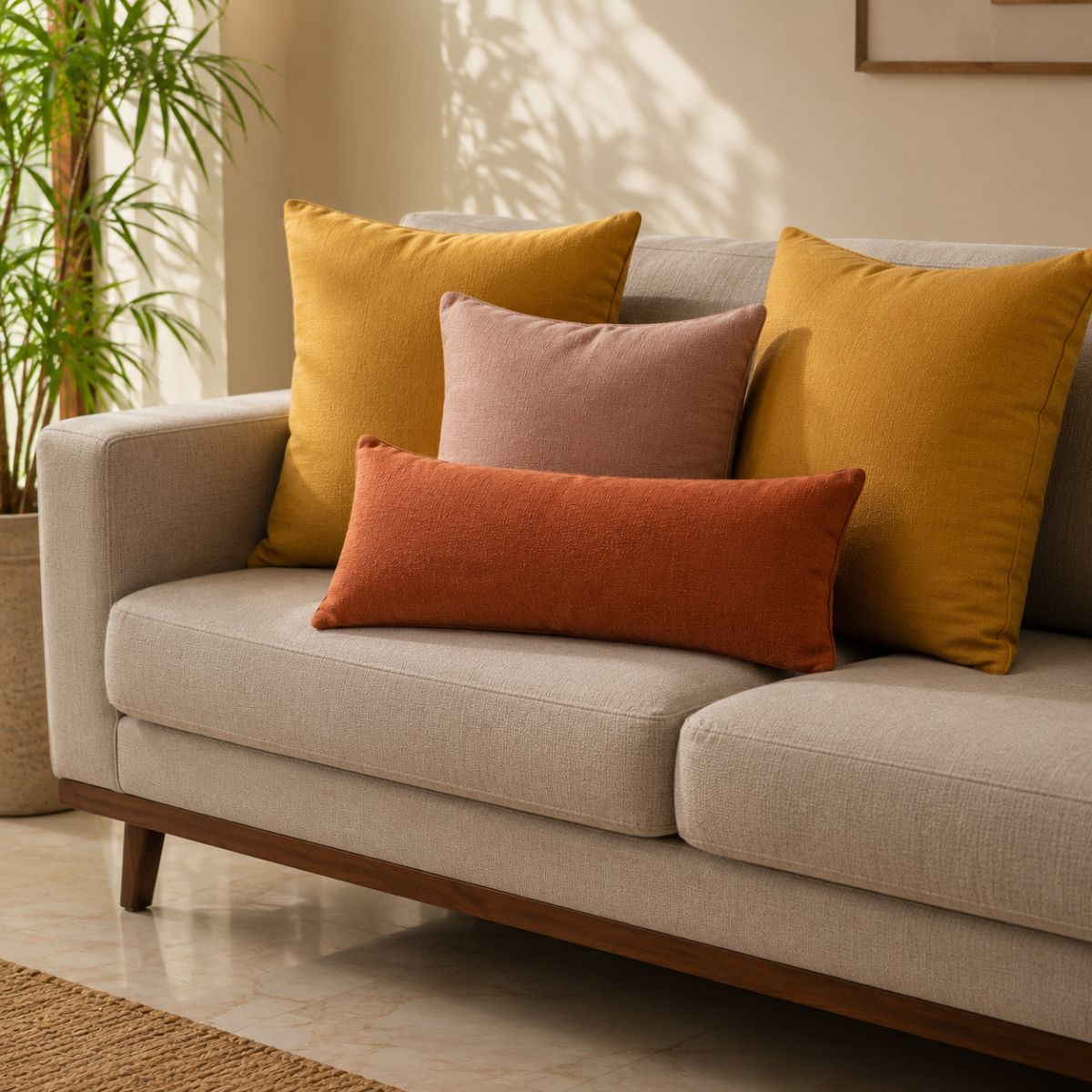

Here’s a thing that happens more often than anyone admits. You see cushions in a showroom or online – they look the perfect size on the display sofa, you order the same ones, they arrive, and somehow they look completely different on your sofa at home. Either they’re too small and sliding around like coasters, or they’re so large you’ve lost a third of your seating. The size that looked right was never actually specified, and you didn’t know to ask. For a standard Indian 3-seater sofa with a seat depth of 50-55 cm, 18×18 inch square cushions are the sweet spot – large enough to have visual weight, small enough to leave room to actually sit. This guide covers every furniture type with the exact sizes that work for Indian homes, plus the one cushion cover rule most people get wrong.
What size cushions do you need for a sofa?
Indian sofas sit 10-15% shallower than their Western counterparts. Most Indian 3-seaters have a seat depth of 50-55 cm; European and American designs typically run 60-65 cm. That gap is why Western cushion guides consistently recommend 20×20 inch as the standard size – and why that advice doesn’t quite land here. A 20×20 inch cushion on a 50 cm deep Indian sofa leaves almost no room to sit properly. You’d be perched on the front edge.
Here’s what actually works for Indian furniture:
| Sofa Type | Seat Depth | Best Cushion Size | Cushion Count |
|---|---|---|---|
| 1-seater / Armchair | 48-52 cm | 16×16 inch | 1-2 |
| 2-seater | 50-55 cm | 16×16 or 18×18 inch | 2-3 |
| 3-seater | 50-55 cm | 18×18 inch | 3-5 |
| L-shaped / Sectional | 55-62 cm | 18×18 + 20×20 inch mix | 5-7 |
| Low-profile / Floor sofa | 40-48 cm | 16×16 inch | Varies |
18×18 inch is your safest default for a standard Indian 3-seater. If your sofa seat depth exceeds 58 cm, move up to 20×20 – it’ll look proportionate. Under 48 cm, 16×16 is the right call or the cushions visually overpower the furniture they’re meant to be sitting on.
One thing worth clarifying: cushion count in the table above refers to decorative cushions. If your sofa has cushions sewn into the back or the seats are loose cushions already, those don’t count. You’re adding on top of what the sofa already has.
How many cushions should a sofa have?
Fewer than you probably think. The most common mistake in Indian living rooms – especially compact 2BHK layouts where the sofa is already doing a lot of work in a smaller space – is over-cushioning. A sofa buried in eight cushions reads as clutter, not comfort. And it means nobody can actually sit down without first doing a cushion-relocation exercise.
The practical upper limits:
- 2-seater: 2-3 cushions maximum
- 3-seater: 3-5 cushions
- L-shaped / sectional: 5-7 cushions
- Accent chair: 1-2 cushions
The odd-number principle is worth following. Three cushions on a 3-seater looks more natural than four. Five on a large sectional looks more curated than six. Even numbers read as deliberate and symmetrical; odd numbers feel relaxed. For most Indian living rooms where the goal is comfortable rather than formal, odd is better.
There’s a simple test for whether you have too many: two-thirds of the sofa should still be usable seating once the cushions are arranged. If you can’t comfortably seat three people on a 3-seater because the cushions have claimed the space, you’ve gone too far.
What size cushions work for beds?
Bed cushions are nearly always decorative – most of them come off before you sleep. Which means the goal isn’t comfort, it’s proportion. Getting the sizes wrong on a bed is more visually obvious than on a sofa because the bed is usually the first thing you see when you walk into a bedroom.
| Bed Size | Sleeping Pillows | Decorative Cushion Size | Count |
|---|---|---|---|
| Single (90 cm wide) | 1 standard (18×28 inch) | 16×16 inch | 1 |
| Double / Queen (150 cm) | 2 standard pillows | 18×18 inch | 2-3 |
| King (180 cm) | 2 standard pillows | 20×20 or 24×24 inch | 2-3 |
The 24×24 inch “euro square” – those large cushions propped against the headboard you see on hotel beds – looks right on a king but overwhelms a queen. On a queen, 18×18 gives you the visual layering without pushing your sleeping pillows forward into an awkward pile.
A formula that works well and takes 10 seconds to disassemble at bedtime: sleeping pillows flat at the back, two 18×18 inch accent cushions propped in front of them, one 12×18 inch lumbar cushion leaning at the very front. Three clear layers, obvious depth, and nothing takes more than one arm-sweep to clear when you’re tired.
What cushion size works for chairs, armchairs and floor seating?
Chairs get vague treatment in most cushion guides. Here’s what actually works across the types you’ll find in Indian homes.
Accent chairs – the kind that sit in a bedroom corner or beside the sofa – need one cushion, not two. 16×16 inch is right for most Indian accent chairs. A 20×20 inch cushion on a narrow accent chair looks like it’s trying to escape the seat. One 16×16 inch, placed slightly off-centre, is the move.
Dining chairs – if you’re adding a back cushion for comfort, 12×16 inch lumbar is ideal. For seat pads, match to slightly inside the seat dimensions: most Indian dining chair seats run 40-44 cm wide, so a 38-40 cm square seat pad fits without overhang.
Floor seating – this is the gap almost every Western cushion guide skips, but gaddi-style floor seating is standard in Indian homes for balconies, puja corners, and study nooks. Standard Indian floor cushions run 24×24 inch square or 20×30 inch rectangular. For floor setups where people lean against a wall, go 24×24 inch with a firm fill – anything smaller bunches and slides, and then nobody uses it. For purely decorative floor cushions that sit in a corner, 20×20 inch works fine.
How do you pick the right cushion cover size for your insert?
This is where most people make a silent mistake that costs them the look they were going for. You can’t buy a 16×16 inch cushion cover for a 16×16 inch insert. The cover ends up looking flat and saggy – not structured, not full, just sort of deflated-looking on the sofa.
The rule: your insert should be 1-2 inches larger than your cover. A 16×16 inch insert goes into a 14×14 or 15×15 inch cover. An 18×18 inch insert goes into a 16×16 inch cover. The slight size difference fills the cover to capacity and creates that firm, overstuffed shape that looks like the product photos.
Why this works: cushion covers are cut with seam allowances. An insert that exactly matches the cover fills it to roughly 85% of its potential volume. That 15% gap is the difference between a cushion that holds its shape and one that flops when you touch it.
One exception: box-seat cushions (the structured cushions that form the actual seat of a sofa, not decorative cushions on top) should always match their cover dimensions exactly. The overstuffed rule applies only to standard square and rectangular decorative cushions.
Wakefit’s cushion covers come in standard Indian sizes – 16×16 inch and 18×18 inch – specifically sized to work with the insert sizes used across most Indian furniture.
How do you mix cushion sizes without it looking messy?
All the same size is the problem, not the solution. Rooms styled with cushions that are all identical in size look like a display unit – very clean, slightly lifeless. The contrast between sizes is what creates the layered, intentional look that reads as styled rather than stacked.
The basic layering formula that works on most Indian sofas:
- Large cushions at the back – 20×20 inch on an L-shaped or 3-seater, 18×18 on a 2-seater. These anchor the arrangement and do the visual heavy lifting.
- Medium cushions in the middle – one size down from your back layer. If you started with 18×18, use 16×16 here.
- A lumbar cushion at the front – 12×18 or 14×22 inch, horizontal, leaning slightly forward. This is the finishing layer that makes it look like a decision was made rather than cushions just piled on.
On a standard Indian 3-seater: two 18×18 inch at the back corners, one 16×16 in the centre, one 12×18 lumbar in front. Four cushions, three distinct sizes, clear depth from back to front. You still have room to sit three people comfortably.
For colour and pattern combinations – how to mix prints without it looking chaotic, how many patterns is too many – Wakefit’s guide on styling cushions on sofas, beds and chairs covers the full approach.
Frequently Asked Questions
1. What is the standard cushion size in India?
16×16 inch and 18×18 inch are the two most common standard cushion sizes in India. 18×18 inch is the default for 3-seater sofas; 16×16 inch is right for 2-seaters, accent chairs, and single beds. Western guides often cite 20×20 inch as standard, but Indian sofas typically have shallower seat depths that make 20×20 look and feel oversized.
2. What size cushion is best for a 3-seater sofa?
18×18 inch for most Indian 3-seater sofas with a seat depth of 50-55 cm. If your sofa has a deeper seat (above 58 cm), 20×20 inch will look proportionate. Stick to 3-5 cushions total – the 3-seater gets crowded fast.
3. How do I know what size cushion cover to buy?
Your cushion insert should be 1-2 inches larger than the cover. Buy a 16×16 inch cover for an 18×18 inch insert, or a 14×14 inch cover for a 16×16 inch insert. This fills the cover fully and gives you the firm, structured shape – matching sizes exactly leaves the cover looking deflated.
4. How many cushions should I put on a sofa?
2-3 for a 2-seater, 3-5 for a 3-seater, 5-7 for an L-shaped sofa. Two-thirds of the sofa should still be usable seating after cushions are placed. Use odd numbers – three looks more natural than four, five reads better than six.
5. What size cushions work for a queen bed?
Two 18×18 inch decorative cushions placed in front of standard sleeping pillows, with an optional 12×18 inch lumbar at the very front. 24×24 inch euro squares are too large for a queen – they push the sleeping pillows into an awkward stack and dominate the bed visually.
6. What is the standard sofa cushion size?
For Indian sofas, 18×18 inch square is the standard for back and decorative cushions. Seat cushions (the cushions you actually sit on) are made to match the sofa’s seat dimensions and aren’t a standard size – they’re cut to the furniture.
7. Can I mix different cushion sizes on the same sofa?
Yes – and you should. All the same size looks flat. The layering formula: large cushions at the back, medium in the middle, one lumbar cushion at the front. Three distinct sizes, front to back, creates depth and makes the arrangement look intentional rather than random.
8. What size are floor cushions in India?
Standard Indian floor cushions (gaddi) run 24×24 inch square or 20×30 inch rectangular. For wall-backed floor seating where people actually lean, 24×24 inch with a firm fill is right – smaller cushions slide and bunch under use. For decorative floor cushions in corners or on balconies, 20×20 inch works fine.


No Comments