
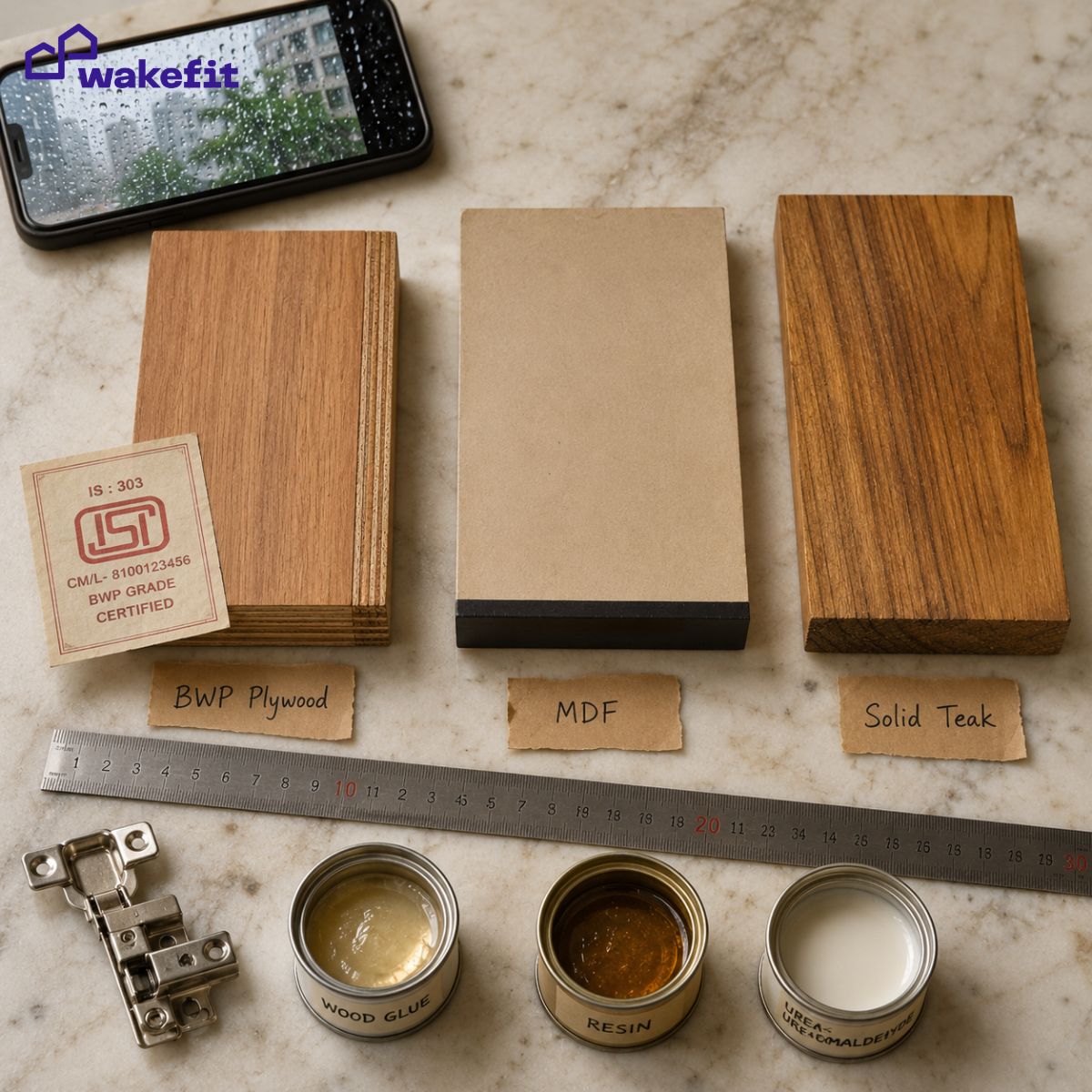

The material your wardrobe is made of will outlast every design decision you make. A wardrobe that looks beautiful in the showroom but uses the wrong core material will start showing problems within a year – swollen shutters, loose hinges, surfaces that bubble near the wall. This guide covers what actually matters before you buy.
What are the main wardrobe materials used in India?
Five materials dominate the Indian wardrobe market: solid wood, plywood, MDF (medium-density fibreboard), particle board, and PVC/WPC. Each handles humidity, daily load, and Indian climate conditions differently.
| Material | Durability | Humidity Resistance | Best For |
|---|---|---|---|
| Solid Wood | Excellent (20+ years) | Moderate – moves with seasons | Premium bedrooms, heirloom pieces |
| Plywood (BWP grade) | Very good (10-15 years) | Excellent | Most Indian homes |
| MDF | Good (7-10 years) | Poor | AC bedrooms, premium paint finishes |
| Particle Board | Fair (3-5 years) | Poor | Low-use, budget, dry rooms |
| PVC/WPC | Good (10+ years) | Excellent | Coastal homes, very humid spaces |
The right material depends mostly on where you live and what your room conditions are like – not just on budget.
Plywood wardrobes are the most reliable choice for most Indian homes
If you can only remember one thing from this guide, make it this: if you are buying a plywood wardrobe, ask for BWP-grade plywood, not MR-grade.
BWP stands for Boiling Water Proof. It is ISI-marked and certified to handle extreme moisture exposure without swelling or delaminating. MR stands for Moisture Resistant – it handles light humidity but will swell under sustained monsoon conditions. The price difference between the two is real, but so is the performance gap.
Plywood’s cross-layer construction also gives it strong screw-holding capacity. This matters more than it sounds. Loose hinges are almost always caused by screws that have lost their grip in the panel – which happens much faster in poor-quality or MR-grade boards. A BWP-grade plywood wardrobe will stay tight through years of daily use.
If you live in Mumbai, Chennai, Kolkata, Kochi, or any other city where humidity stays high for months at a stretch, BWP plywood is the only material you should seriously consider.
Solid wood wardrobes are worth the premium only in the right conditions
Solid wood – teak, sheesham, and mango wood are the most common – is genuinely long-lasting. A well-made solid wood wardrobe can last decades. But it comes with conditions that most buyers do not factor in.
Wood expands and contracts with temperature and humidity. In non-AC rooms in humid cities, solid wood shutters can become difficult to open and close in peak monsoon because the wood has swollen. They ease back in drier months, but the repeated movement stresses the joints and hardware over years.
The premium makes sense when you are furnishing a master bedroom that stays air-conditioned, or when you want a piece that can be passed down. For a study room, a storage-heavy children’s room, or any rented home, the practical case for solid wood weakens considerably.
MDF wardrobes give you the best surface finish at a lower cost
MDF gives you the smoothest, most paint-ready surface of any wardrobe material. This is why premium finish options – PU paint, high-gloss acrylic, lacquer – almost always use MDF as the substrate. The uniform, fine-grained surface holds paint evenly in a way that plywood cannot match.
The limitation is moisture. MDF absorbs humidity readily and can develop swelling along edges within a couple of years if exposed to non-AC conditions – especially on ground floors, near bathroom walls, or in coastal cities.
One important thing: many brands describe their wardrobes as “engineered wood” without specifying what that means. Plywood is technically engineered wood. So is MDF. If a brand says “engineered wood” and will not clarify the specific material, ask directly. The answer determines how your wardrobe performs five years from now.
The right wardrobe material depends on your city and home
| Your situation | Best material choice |
|---|---|
| Coastal or humid city (Mumbai, Chennai, Kolkata, Kochi) | BWP-grade plywood or WPC |
| Dry city, AC bedroom (Delhi, Jaipur, Ahmedabad) | Plywood or MDF |
| Ground floor, any city | BWP-grade plywood only |
| Rented flat, tight budget | Plywood if humid; MDF if AC room |
| Master bedroom, premium look | Solid wood or MDF with PU finish |
| Small room, needs lightweight unit | WPC or aluminium frame |
One often-ignored factor: whether you own the home or rent it. In a rental, spending heavily on a solid wood built-in wardrobe rarely makes financial sense. A well-made freestanding plywood wardrobe is the smarter move – you can take it when you leave.
Four things to check before buying any wardrobe
The material matters most, but these four checks help you avoid the common traps.
Ask for BWP certification on plywood wardrobes. A reputable brand can show you the ISI mark or grade certificate. If they cannot, assume it is MR-grade or lower.
Check MDF density if it is an MDF wardrobe. Standard MDF should be 650-700 kg/m3 or higher. Budget wardrobes often use lower-density boards that swell and chip faster.
Look at the back panel. This is where manufacturers cut costs most aggressively. A good wardrobe uses 6-9mm plywood or HDF for the back panel. Thin, cardboard-like hardboard is a red flag – it warps first, and it cannot support hooks or internal fittings reliably.
Test the hardware before you buy. Open and close the shutters several times. Soft-close hinges should close silently. Full-extension drawer slides should pull out completely without wobbling. Bad hardware on a good material is still a bad wardrobe.
Wakefit’s wardrobe collection covers a range of material and finish options, including sliding wardrobes and wardrobes with mirror that specify the core material clearly. For more on why India’s climate affects wooden furniture specifically, this guide on how humidity affects wooden furniture is worth reading before you decide.
Frequently asked questions about wardrobe materials
Is MDF or plywood better for a wardrobe?
For most Indian homes, BWP-grade plywood is better. It handles humidity, holds screws well, and lasts longer without air conditioning. MDF is better only if you want a premium painted finish and your room stays air-conditioned year-round.
Which wood is best for wardrobes in India?
Plywood – specifically BWP-grade – is the most practical choice for India’s climate. Among solid woods, teak offers the best natural moisture resistance, but comes at a significant premium and still requires a climate-controlled room to perform at its best.
Is a plywood wardrobe better than a PVC wardrobe?
PVC and WPC wardrobes have excellent moisture resistance and work well in bathrooms or very humid coastal homes. For general bedroom use, good-quality plywood wardrobes offer better structural strength and hold heavier loads without flexing over time.
Is an aluminium wardrobe better than a plywood wardrobe?
Aluminium wardrobes are rust-proof, termite-proof, and highly durable in coastal areas. They tend to have an industrial aesthetic and can feel cold. Plywood wardrobes offer more design flexibility and a warmer look for most bedrooms.
How long does a plywood wardrobe last?
A BWP-grade plywood wardrobe with quality hardware lasts 10-15 years easily. With proper care – keeping the interior dry, not overloading shelves, and servicing hinges when needed – it can last considerably longer.
What is the difference between BWP and MR plywood?
BWP (Boiling Water Proof) plywood uses phenolic resin and resists extreme moisture. MR (Moisture Resistant) uses urea-formaldehyde resin that handles light humidity but fails under sustained monsoon exposure. BWP costs more but is the only grade worth buying for most Indian homes.
Can I use a particle board wardrobe in a bedroom?
Particle board works in dry, air-conditioned rooms with light use. It is not suitable for ground floors or humid climates – it absorbs moisture quickly and the internal structure deteriorates fast. The low upfront price often means higher replacement costs within a few years.
What should I ask before buying a wardrobe?
Three questions: What is the core material and grade (BWP plywood, MR plywood, or MDF)? What is the back panel made of and how thick? Do the hinges and drawer slides have a warranty? If a salesperson cannot answer these specifically, that itself tells you something useful.


No Comments