

Most people notice the problem too late. A wardrobe door that stopped closing properly sometime in August. A dining chair that wobbles because the joint has come loose. A white patch on the underside of a bedside table that, on closer inspection, is mould. All three of these started weeks before they became visible – and all three had the same cause. Wood absorbs moisture from the air the same way a sponge does. When indoor humidity climbs above 65% and stays there, the fibres swell. When it drops below 35%, they crack. The safe range your wooden furniture actually needs is 45-55% relative humidity. This guide covers why damage happens, which wood holds up best in Indian conditions, and what to do if you’re already past the early warning signs.
How does humidity damage wooden furniture?
Wood is hygroscopic – it’s always either absorbing moisture from the air around it or releasing it. That sounds harmless until you factor in India’s humidity range. Delhi swings from 90% in peak monsoon to under 30% in February. Mumbai sits at 70-85% for six months straight. The wood in your furniture is expanding and contracting with every swing, and it doesn’t do so evenly – different parts absorb at different rates, which creates internal stress.
That stress shows up in three stages, each one harder to undo than the last:
- Swelling and sticking – still reversible. Drawers suddenly need force to open. Cabinet doors don’t sit flush anymore. The surface feels faintly spongy in places. At this stage you haven’t lost anything yet. Cut the humidity, let the wood dry slowly, and it comes back. The mistake most people make here is waiting to see if it “sorts itself out” in a few weeks – it doesn’t.
- Warping and loose joints – partially fixable. Now there’s a visible bow in the surface. Joints where two pieces of wood meet have started to separate. The finish is bubbling at the edges. You can still fix this, but it takes sanding, re-gluing, and re-finishing – not something you can sort in an afternoon.
- Mould and structural failure – call a professional. White or dark patches have appeared, usually inside wardrobes or on the backs of pieces pushed against damp walls. The joints have given up. At this stage, a professional restoration is your only real option. DIY repairs hold for maybe a season.
Act at the first sign of sticking drawers. Waiting just two more weeks after you notice it roughly doubles what it costs to fix.
Which wood type handles Indian humidity best?
Here’s the thing people don’t tell you when you’re furniture shopping: the wood type matters less than most salespeople imply, but it matters more than most buyers realise. Teak has natural oils baked into its fibres. Those oils don’t just make it look good – they actively repel moisture absorption in a way that no finish can fully replicate in cheaper wood. Sheesham is dense enough that moisture takes a long time to work through it. MDF, on the other hand, is compressed sawdust and adhesive. It doesn’t resist humidity; it surrenders to it.
| Wood Type | Humidity Resistance | Maintenance Level | Best For | India Price Range |
|---|---|---|---|---|
| Teak | Excellent – natural oils repel moisture | Low | Coastal homes, outdoor-adjacent rooms | Premium (₹800-1,500/sq ft) |
| Sheesham (Indian Rosewood) | Very good – dense grain slows absorption | Low-Medium | Indoor furniture, wardrobes, beds | Mid-range (₹400-800/sq ft) |
| Acacia | Good | Medium | Indoor furniture in moderate humidity | Mid-range |
| Solid Mango / Pine | Moderate – absorbs faster than hardwoods | High | Dry climate rooms, budget use | Budget |
| Engineered Wood (MDF / Plywood) | Low – swells and delaminates above 65% | High | AC rooms only | Budget |
If you’re in a coastal city – Mumbai, Kochi, Chennai – teak wood is worth the premium. Your humidity is high for half the year and the cheaper options will need replacing or expensive repairs within five to seven years. For most Indian homes inland, sheesham hits the right balance of durability and price. Engineered wood is fine in an air-conditioned bedroom, but keep it out of kitchens and bathrooms entirely.
For a full comparison of how teak, sheesham, and other wood types differ in grain, density, and long-term durability, Wakefit’s guide to different wood types for furniture has all the detail.
How should you protect wooden furniture during monsoon season in India?
Most furniture care articles give you a single list of tips and call it done. The problem is that monsoon humidity and dry-winter dryness are two completely different threats, and what helps in June can actually hurt in December.
During monsoon (June – September):
- Get indoor humidity to 45-55% and keep it there – AC works, a dehumidifier works better for rooms you’re not cooling. A basic hygrometer costs ₹500-800 at any hardware store and tells you the exact number. Don’t guess.
- Polish before the season, not during it. Applying PU or melamine polish once the rains have started traps existing moisture inside the wood. Do it in May.
- Put silica gel packs inside wardrobes and storage beds. Your dehumidifier handles the open air – it doesn’t reach the trapped air inside closed furniture.
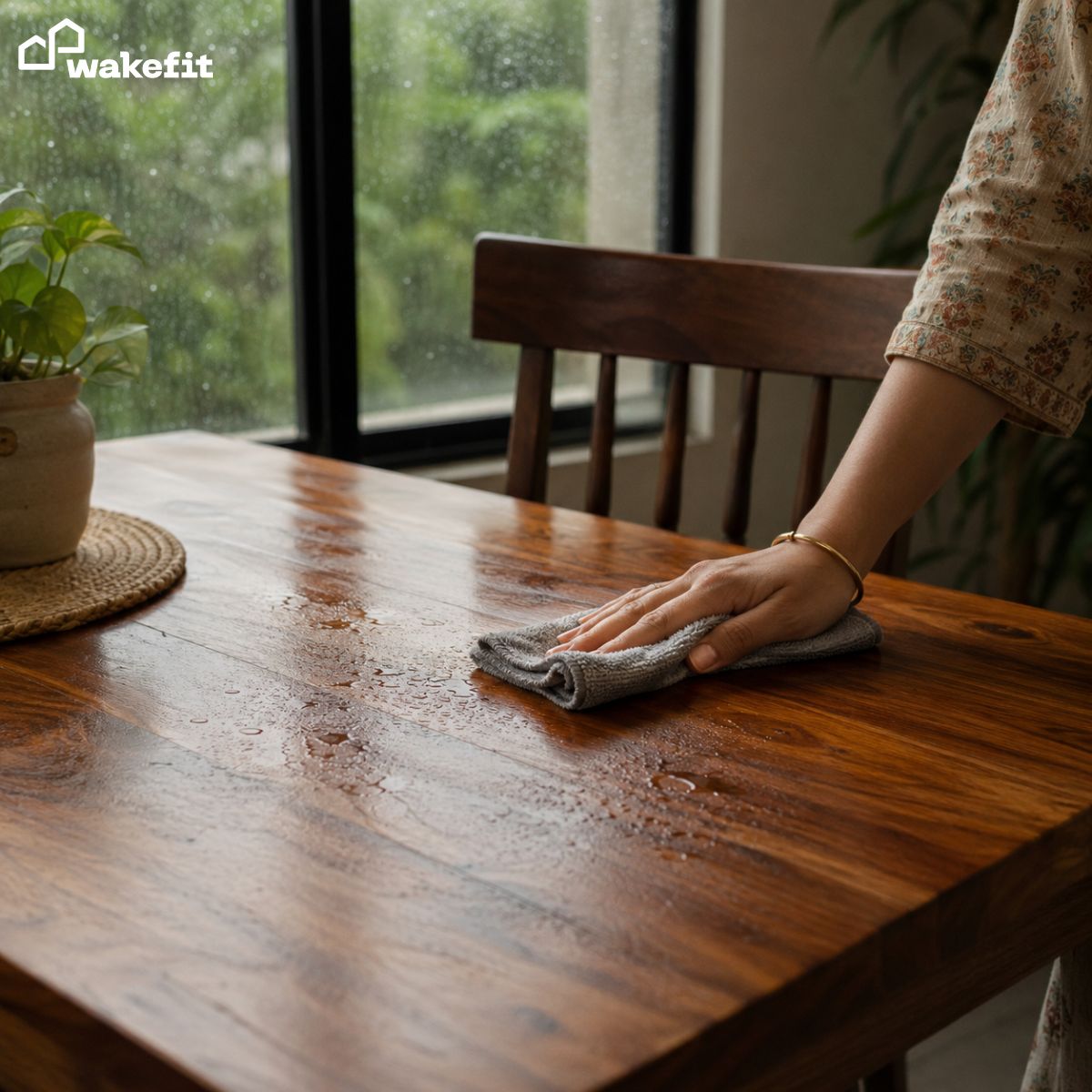
- Wipe wooden surfaces every morning with a dry microfibre cloth. Not damp – dry. A wet cloth during monsoon is actively making things worse.
- Pull furniture 2-3 inches away from walls. Walls absorb moisture and then radiate it back out. Furniture pressed against them gets a continuous dose.
During dry winter (November – February):
Delhi and other North Indian cities see indoor humidity drop to 25-30% in winter. That’s below the safe threshold, and the wood starts cracking and developing joint gaps – a problem most people blame on “cheap furniture” when it’s actually just under-oiled wood in overly dry air.
- Apply natural wood oil – teak oil, linseed oil, or Danish oil – every 2-3 months through the dry season.
- Keep furniture away from room heaters. Direct heat pulls moisture out of wood faster than it can adjust.
- Running a humidifier for a few hours a day in the bedroom keeps the ambient humidity from going below 35%.
How do you repair humidity-damaged wooden furniture?
The repair depends entirely on how far the damage has gone. Here’s what to do at each stage.
Stage 1 – Drawers sticking, surface feels soft:
- Remove the drawer or door. Put it in a room with AC or a dehumidifier running at 45-50% humidity.
- Leave it for 48-72 hours. Don’t speed this up with a heat gun or hairdryer – drying the surface fast while the interior is still wet causes the finish to crack.
- Once dry, sand the contact edges lightly. Rub beeswax or paraffin wax onto the sliding surfaces so it glides cleanly.
- Give it two weeks before you decide it’s fixed. Sometimes it swells back if the room humidity isn’t maintained.
Stage 2 – Visible warping, joints separating:
- Re-glue loose joints with PVA wood glue. Clamp properly for at least 24 hours – this step gets rushed more than any other.
- Lay the warped piece flat on a level surface and put weight on it in a humidity-controlled room. Mild warps under 5mm often correct themselves over 2-3 days as moisture equalises.
- Sand and re-finish once it’s completely dry.
- If the warp is more than 1cm, get a professional to look at it. Forcing badly warped wood flat without kiln treatment usually cracks it.
Stage 3 – Mould has appeared:
- Take the piece outside. Wipe the affected area with a cloth dampened in white vinegar or diluted wood cleaner. Don’t soak it.
- Let it dry fully in open shade – not direct sunlight, which bleaches the finish unevenly.
- Once dry, sand the patch lightly, treat with antifungal wood primer, and re-finish.
- Fix the source of humidity in the room. Mould will be back within a season if you don’t.
What furniture finish best protects wooden furniture from Indian humidity?
The finish on the surface of your furniture is doing most of the protective work – more than people give it credit for. A properly finished piece of pine will outlast a bare teak piece in a humid room. Here’s how the three main finishes compare.
PU (Polyurethane) finish lays down a hard, moisture-resistant surface layer that stops ambient humidity from reaching the wood fibres underneath. Most Wakefit beds use a PU finish on their engineered wood components – it’s why they don’t need the same maintenance routine as raw or oiled wood in normal Indian homes. The tradeoff: PU does wear down, and needs re-application roughly every 3-4 years once you start seeing dullness or small scratches.
Melamine finish is harder and more scratch-resistant than PU, which is why it’s the default for study tables and dining furniture that takes daily abuse. It’s less flexible, so the edges can chip over time – but for flat surfaces in a humid environment, it’s the most durable option of the three.
Natural oil finish – teak oil, linseed, Danish oil – works differently from the other two. Instead of sitting on the surface, it soaks into the wood fibre itself. That preserves the natural look and texture of solid wood, and it’s straightforward to re-apply at home. The honest limitation: it offers less humidity resistance than PU or melamine. For teak and sheesham pieces where the grain is the whole point, it’s still the right call – just commit to re-oiling every 3-6 months through the year.
All Wakefit wooden furniture ships pre-finished and comes with home delivery and installation – which means you can decide during setup exactly how far from the wall to place each piece, before it’s fixed in position.
Frequently Asked Questions
1. Does humidity cause wooden furniture to warp?
It does, but not instantly. When indoor humidity stays above 65% for two weeks or more, wood fibres absorb moisture unevenly across different parts of the piece – the stress from that uneven expansion is what causes the visible bowing. It’s a slow build, which is also why people often don’t connect the cause and the effect.
2. Which wood is best for humid climates in India?
Teak, for coastal cities and high-humidity rooms – its natural oils are genuinely effective, not just a marketing claim. Sheesham for most Indian homes inland – better humidity resistance than pine or MDF at a fraction of teak’s price. Keep engineered wood (MDF, particle board) in air-conditioned rooms only.
3. How do I protect wooden furniture during monsoon?
Keep indoor humidity between 45-55% with AC or a dehumidifier. Polish before June, not after the rains start. Silica gel packs inside enclosed furniture, dry microfibre wipe every morning, and pull furniture 2-3 inches from walls. That combination handles most of what monsoon throws at it.
4. Can warped wood furniture be repaired?
Warps under 5mm – often yes, with humidity reduction and some patience. Warps over 1cm usually need a professional. The window closes fast: a warp that’s been sitting for a month is significantly harder to correct than one you caught in the first two weeks.
5. Is engineered wood good for humid areas in India?
Honestly, no – not without control. MDF swells and the layers delaminate when humidity consistently goes above 65%. If it’s what you have, keep the room air-conditioned, make sure all surfaces and cut edges are sealed with PU finish, and don’t push it against damp walls.
6. How do I remove mould from wooden furniture?
White vinegar or diluted wood cleaner on a damp cloth, applied outside. Dry fully in open shade, sand lightly, antifungal primer, re-finish. The finish part matters – skipping it means the mould has a raw surface to return to. And fix the room humidity, or it will come back regardless.
7. What indoor humidity level is safe for wooden furniture?
45-55% is the stable zone where wood neither absorbs nor loses moisture rapidly. Above 65%, swelling and mould become real risks. Below 35%, cracking and joint gaps start showing up. A basic hygrometer from a hardware store (₹500-800) takes the guesswork out completely.
8. How often should wooden furniture be polished?
PU-finished pieces: every 3-4 years, or when you notice the surface losing its sheen. Oil-finished pieces (teak oil, linseed): every 3-6 months – it’s a 20-minute job and it makes a real difference. Melamine-finished pieces rarely need re-polishing; cleaning is what maintains them.
No Comments