
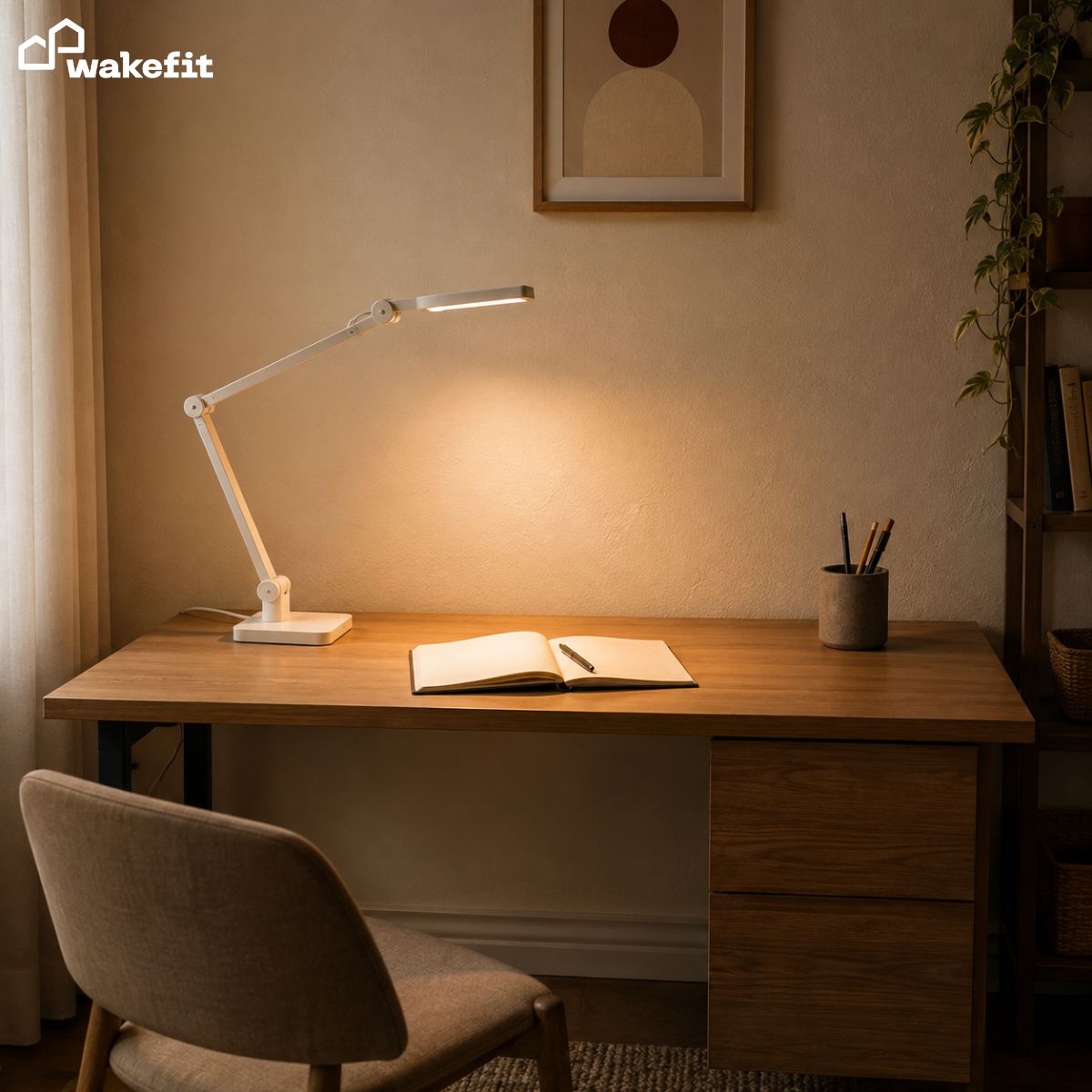

Place your study lamp on the left side of your desk if you’re right-handed, and on the right side if you’re left-handed. Everything else – height, angle, brightness – adjusts from there based on what you’re doing and how the rest of your room is lit.
Most people get the basic rule right but miss the four variables that change the correct placement: whether you’re reading a book, using a laptop, or writing by hand; how much ambient light is already in the room; what direction natural light enters from; and whether you have an adjustable lamp or a fixed one. Get these right and your eyes stay comfortable for hours. Get them wrong and you’ll have a headache by 10 PM.
Place the lamp on the opposite side of your writing hand – here’s why
If you write with your right hand, your lamp goes on the left. Left-handed, it goes on the right.
The reason is straightforward: when the light source is on the same side as your writing hand, your hand casts a shadow directly over your work. You’re writing in your own shadow all evening without realising it. Moving the lamp to the opposite side means light falls across your desk from the side – the shadow now falls away from your notes, not across them.
This is the single highest-impact adjustment most students never make. Everything else is fine-tuning by comparison.
How high should a study lamp sit above your desk surface?
The bottom of your lamp’s shade should sit at roughly eye level or just below it when you’re seated. In practical terms, this is about 40 to 50 cm (16 to 20 inches) above the desk surface for a standard chair height.
Too low, and the bare bulb sits in your direct line of sight – you’ll catch glare every time you look up from your book. Too high, and the light spreads too broadly and loses intensity exactly where you need it most.
A height-adjustable study lamp solves this automatically since you can dial in the exact position for your desk and chair combination. If your lamp is fixed-height, the quick check is this: when seated at your normal study posture, you should never be able to see the bare bulb. If you can, the shade is too low or the lamp needs to be raised.
The right placement depends on what you’re doing at the desk
Reading, writing by hand, and working on a laptop each need the lamp in a slightly different position. Most people pick one position and use it for everything – which means they’re optimising for none of these tasks.
| Task | Lamp position | Height above desk | Angle | Reason |
|---|---|---|---|---|
| Reading books | Opposite side, slightly behind the book | 40-50 cm | 30 degrees from side | Light falls across the page without creating glare on the paper surface |
| Writing by hand | Opposite side of writing hand | 40-50 cm | 30 degrees from side | Eliminates hand shadow falling across the page |
| Laptop work | 45 degrees to the side – left or right | 50-60 cm | 45 degrees | Avoids reflections on screen; higher position keeps light off the display |
| Video calls | Behind the laptop, slightly elevated, facing you | 60+ cm | Facing your face | Creates even face lighting without washing out the screen |
If your desk doubles as both a study and work surface – which is common in Indian homes where a study table serves multiple purposes – an adjustable-arm lamp is worth the investment precisely because it lets you change position without moving the whole base.
How Indian room lighting changes the placement equation
Most desk lamp guides from Western sources assume your ambient room light comes from ceiling fixtures placed centrally, creating even, diffused light as a base. Indian study rooms are different in two important ways.
First, the standard overhead tubelight in Indian homes creates flat, directionless ambient light. It illuminates the room but produces hard shadows directly beneath objects – including your hand and notebook. A correctly placed study lamp compensates for this by adding directional light from the side, filling in those desk-level shadows.
Second, natural light in India is often harsh and directional. If your desk is near an east-facing window, you’ll get intense morning sunlight between 7 and 10 AM that creates glare on both paper and screens. In this situation, position your study lamp on the window side – it balances the ambient light intensity so your eyes aren’t constantly adjusting between a bright window and a darker corner of the desk.
The Bureau of Indian Standards IS 3646 recommends a minimum of 300 lux for reading and writing tasks. A standard LED study lamp at 40 to 50 cm height achieves this – but only when placement is correct. An incorrectly positioned lamp of any wattage will still cause strain.
Pointing the lamp directly at your work causes more eye strain than no lamp at all
This is the most counterintuitive mistake in desk lighting. When the lamp is directly in front of you and angled straight down at your work, light bounces off white paper and screen surfaces directly back into your eyes. This is called direct glare, and it is harder on your eyes than dim light – because your pupils are constantly contracting and expanding as they adjust between the bright reflection and the darker surrounding room.
The fix is simple: the lamp should always light your work from the side, not from directly above or in front of it. Light coming from 30 to 45 degrees to the side illuminates the surface without creating a reflection back toward your eyes.
This is also why a lamp behind the monitor – pointed toward your face – is worse than no lamp at all during laptop work. It creates an opposite-brightness situation where your face and keyboard are bright but your screen appears washed out, forcing your eyes to readjust every few seconds.
5 study lamp placement mistakes most students make
1. Lamp placed directly in front, not to the side. Light bounces off paper and screen directly into your eyes. Move it 30 to 45 degrees to the side so it illuminates from an angle.
2. Lamp on the same side as the writing hand. Your hand casts a shadow across your work all evening. Switch it to the opposite side.
3. Shade too close to the desk surface. The bare bulb sits in your sightline every time you look up. Raise the lamp until the shade base is at seated eye level.
4. Bright study lamp in a completely dark room. The high contrast between a brightly lit desk and a dark room is more fatiguing than studying in dim uniform light. Always keep some ambient room lighting on alongside your study lamp – even just the overhead light at low intensity.
5. Using a fixed lamp for both reading and laptop work. The correct position differs between these two tasks. If you switch between them on the same desk, a fixed lamp will always be wrong for one of them. An adjustable-arm study lamp lets you reposition without moving the base every time you switch tasks.
How to test if your study lamp placement is correct – a 30-second check
You don’t need a lux meter. Three quick tests cover everything.
Shadow test: Hold your palm flat over the area where you read or write, about 10 cm above the surface. The shadow your hand casts should fall away from your work area – toward the lamp side. If the shadow falls across your notes, the lamp is on the wrong side.
Glare test: Sit in your normal study posture and look up from your work toward the lamp. If you can see the bare bulb or feel brightness directly in your eyes, the lamp is too low. Raise it until the shade covers the bulb from your seated eye level.
Reflection test: Look at your laptop screen or a white page on your desk. If you see a bright spot or reflection from the lamp, the lamp is in your direct sightline. Move it 30 degrees further to the side.
All three pass? Your lamp is correctly placed. If your current lamp doesn’t allow enough adjustment to pass all three, the issue is the lamp itself – most basic fixed-shade lamps can’t be positioned correctly for every task. A study lamp with an adjustable arm removes this constraint entirely.
Frequently asked questions
1. Should a study lamp be on the left or right side of the desk?
On the opposite side of your dominant writing hand. Right-handed: lamp on the left. Left-handed: lamp on the right. This prevents your writing hand from casting a shadow over your notes.
2. What is the correct height for a study lamp above the desk?
The bottom of the lampshade should sit at roughly eye level when seated – approximately 40 to 50 cm above the desk surface for standard chair heights. The bare bulb should never be visible from your normal seated posture.
3. Is warm light or cool light better for studying?
Cool white light (5000 to 6500K) is better for focused tasks – reading, writing, problem-solving. It increases alertness and reduces the tendency to feel drowsy. Warm light (2700 to 3000K) is more relaxing but reduces sharpness for detail work. Most dedicated study lamps use cool or neutral white as default.
4. Can I place my study lamp directly in front of me?
No. A lamp placed directly in front creates glare as light bounces off white pages and screens back into your eyes. Position it 30 to 45 degrees to the side so light falls across the work surface at an angle rather than reflecting straight back toward you.
5. Should I use a study lamp even if the overhead room light is already on?
Yes. Overhead tubelights in Indian homes create flat ambient light with hard downward shadows at desk level. A side-positioned study lamp adds directional light that fills those shadows specifically on your work surface, reducing eye strain during focused tasks.
6. How far should the study lamp be from my laptop screen?
At least 30 to 40 cm from the screen edge, positioned to the side – not behind or in front of the monitor. The lamp should illuminate your keyboard and desk surface, not the screen itself. Light hitting the screen directly causes reflections that wash out the display.
7. Is one study lamp enough or do I need two?
For a single-person desk, one correctly placed study lamp combined with ambient room lighting is sufficient. If you have a large desk (over 120 cm wide) or share the desk, a second lamp at the opposite end prevents dark zones on the far side of the surface.
8. What happens if I study with only a desk lamp and no other room light?
Your eyes strain more, not less. The high contrast between a brightly lit desk surface and a dark room forces your pupils to constantly readjust as your gaze shifts. Always keep some ambient room light on alongside your study lamp – even at low intensity. The desk lamp handles task lighting; the room light handles background balance.
Data source: Bureau of Indian Standards IS 3646 – Interior Illumination (Part 1): General Requirements and Recommendations for Working Interiors.


No Comments