
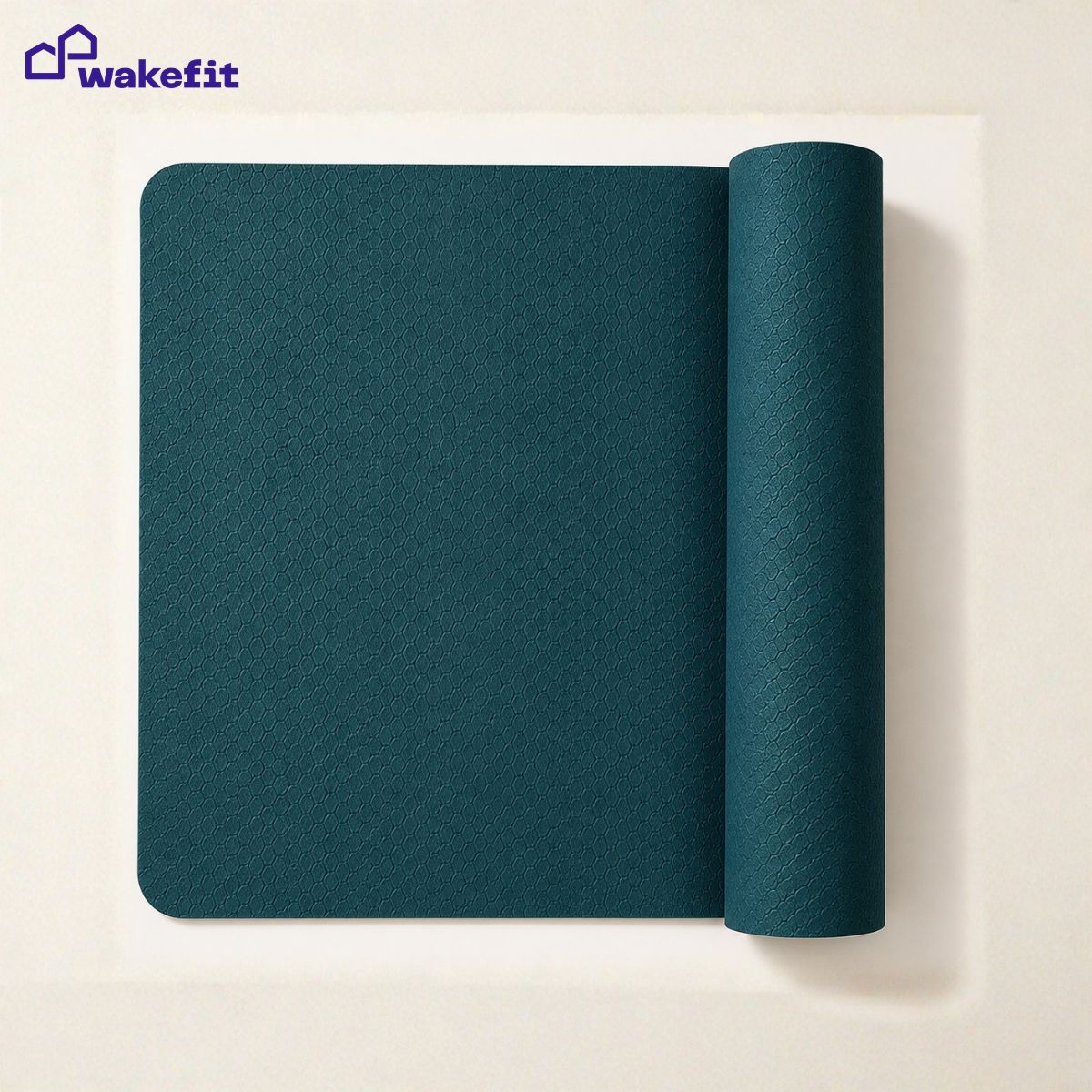

For Indian homes with marble or tile floors, 6mm is the minimum thickness you need – anything thinner won’t protect your knees and wrists during floor poses. Beyond that, the right yoga mat comes down to four decisions: material, thickness, size, and the type of yoga you practice.
Most buying guides skip the floor-type detail and go straight to brand recommendations. This one works the other way – once you know what your practice and floor need, the right mat becomes obvious. The options narrow down fast.
The one number that matters most: thickness for Indian floors
Yoga mat thickness ranges from 1.5mm (travel mats) to 8mm (extra cushion). For most people in India, the right answer is 6mm.
Here’s why. Marble and tile – the dominant flooring in Indian homes and apartments – are unforgiving surfaces. A 4mm mat compresses further under body weight, leaving your knees and wrists with effectively 2-3mm of cushioning during table pose, low lunge, or any kneeling sequence. That is not enough for a sustained practice. A 6mm mat holds its thickness under load and gives your joints the buffer they need.
4mm mats work well on wooden floors or carpet, where the surface itself provides some give. If you practice on these surfaces – or if you prioritize balance over cushioning (as advanced practitioners often do) – 4mm is a valid choice. For beginners on hard floors, 6mm is the safe starting point.
Travel mats at 1.5-2mm fold into a bag and are fine for occasional use. They are not a substitute for a daily practice mat – the joint impact over time adds up.
Yoga mat materials compared: TPE, PVC, rubber, and cork
Material determines grip, durability, eco-impact, and price. These four are the main options you’ll encounter in India.
| Material | Grip (dry) | Grip (sweaty) | Durability | Eco-friendly | Best for |
|---|---|---|---|---|---|
| PVC | High | Slippery | 5-7 years | No | Budget buyers, dry practice |
| TPE | Good | Moderate | 3-5 years | Recyclable | Beginners, everyday home practice |
| Natural Rubber | Excellent | Good | 5+ years | Yes | Intermediate to advanced practitioners |
| Cork | Moderate | Excellent | 3-5 years | Yes | Hot yoga, sweaty practice |
A note on cork: it is counterintuitive but cork grip actually improves as moisture increases. If you sweat heavily during practice, a cork surface is more reliable than PVC or TPE, both of which become slippery when wet. For dry practice in an air-conditioned room, PVC and TPE outperform cork.
NBR (nitrile butadiene rubber) is a fourth option common in budget mats – softer and more cushioned than PVC, decent for gentle yoga and meditation, but less durable under daily intense practice.
Which mat suits your practice type?
The same mat that works for restorative yoga will frustrate a vinyasa practitioner. Match the mat to the movement.
| Practice type | Recommended material | Thickness | Key requirement |
|---|---|---|---|
| Beginner / home yoga | TPE or PVC | 6mm | Cushioning for long holds and floor poses |
| Hot yoga / power yoga | Cork or rubber | 4-6mm | Grip that holds under sweat |
| Flow / vinyasa | TPE or rubber | 4mm | Lightweight, responsive surface for transitions |
| Restorative / yin | TPE or PVC | 6-8mm | Maximum cushioning for long floor holds |
| Travel practice | TPE (foldable) | 1.5-2mm | Packable, lightweight |
| Meditation | TPE or NBR | 6mm+ | Comfort over grip – you’re not moving |
Yoga mat size guide: standard, large, and travel
Standard yoga mat dimensions are 183cm x 61cm. This fits most adults comfortably for all standing and floor poses. If you are taller than 5’10” or have a broader frame, a large mat (183cm x 66-76cm) gives you the lateral space you need without constantly stepping off the edges.
Width matters more than most people realise. A narrow mat means your elbows and knees frequently land on bare floor during wide-stance poses – which defeats the purpose of having a mat in the first place.
Travel mats typically run 173cm x 61cm and fold rather than roll. They fit in a backpack or carry-on. The trade-off is thickness – at 1.5-2mm, they are fine for a session at a hotel or friend’s place but not for daily practice on hard floors.
What beginners should specifically look for in a yoga mat
If you are new to yoga, three things matter above everything else.
6mm thickness. You don’t yet have the conditioning to compensate for a thin mat. Your knees, wrists, and hips need the cushioning while your body adapts to floor-based movement.
A non-slip surface. Sliding hands during downward dog is not a form problem for beginners – it is a mat problem. Look for a textured or embossed surface. Test by placing your palm flat and pressing – it should grip, not slide.
TPE or PVC material. Both are easy to clean, durable for regular use, and reasonably priced. Natural rubber and cork are excellent materials but they cost more – a reasonable upgrade once you’ve committed to a regular practice. Start with TPE and decide if you want to invest further after 6 months.
What you don’t need as a beginner: alignment lines printed on the mat (they create anxiety about positioning that experienced teachers say is counterproductive), extra-thick 8mm mats (too spongy for balance poses), or premium carry straps (a standard rolled mat tucks under your arm just fine).
Wakefit’s yoga mat range covers both 4mm and 6mm options in TPE and NBR – a practical starting point if you want to compare thickness in one place.
Features worth paying for – and ones that aren’t
Worth it:
Closed-cell foam. Open-cell foam absorbs sweat inside the mat – it becomes unhygienic quickly and is difficult to clean fully. Closed-cell construction means sweat sits on the surface and wipes off. Most TPE and PVC mats are closed-cell; check the product description before buying.
Double-layer construction. A dense bottom layer for stability, a softer top layer for grip and cushioning. Better joint protection than a single-layer mat of the same total thickness.
Textured grip surface. Embossed or dotted surfaces outperform smooth ones. Grip degrades with use – a textured surface lasts longer before becoming slippery.
Not worth it (for most people):
Alignment lines. Useful for teachers demonstrating in class. For home practice, they create unnecessary mental noise about whether your foot is at the right line.
8mm+ thickness. Feels luxurious but reduces balance feedback. In warrior poses and single-leg balances, the spongy surface makes stability harder, not easier. Necessary only if you have specific knee or joint conditions.
Brand-name microfibre toppers. The towel-style surface is designed for hot yoga with heavy sweat. For a regular home practice, a good TPE or rubber surface outperforms it and needs no separate washing.
How long does a yoga mat last? Signs it’s time to replace it
A quality TPE or rubber mat used daily lasts 3-5 years. A PVC mat in the same conditions lasts 5-7 years. Budget NBR foam mats typically give 6-12 months of daily use before the surface starts breaking down.
Four signs your mat needs replacing:
Flaking or peeling surface. The top layer is breaking down. It will get worse and start transferring material to your hands and clothes.
Uneven compression. Press your knees into different spots on the mat – if some areas feel noticeably thinner or harder than others, the foam has permanently compressed. The cushioning is uneven and unreliable.
Persistent odour that doesn’t leave after cleaning. Sweat has penetrated the foam structure. No cleaning method will fully remove it once it’s inside the material.
Loss of grip even on a clean, dry surface. The surface texture has worn smooth. This is a safety issue – slipping during poses is how wrist and ankle injuries happen.
Proper care extends mat life significantly. Wipe down with a damp cloth after every session. Deep clean with mild soap and water every 2-4 weeks. Roll loosely rather than folding, and store out of direct sunlight – UV degrades both rubber and TPE faster than regular use does.
Frequently asked questions
1. Which yoga mat thickness is best for beginners?
6mm for Indian homes with marble or tile floors. It provides enough cushioning for knees and wrists while your body builds the conditioning needed for floor poses. 4mm works on wooden or carpeted surfaces where the floor itself provides some give.
2. What is the best yoga mat material?
For most people: TPE. It balances grip, durability, weight, and price better than alternatives. Natural rubber outperforms TPE on grip and lifespan but costs more. Cork is best for hot yoga or heavy-sweat practice. PVC is the most affordable and durable but not eco-friendly.
3. What is the standard yoga mat size?
183cm x 61cm. This fits most adults for all standard poses. If you are taller than 5’10” or broad-shouldered, look for a large mat at 183cm x 66-76cm for adequate lateral space.
4. Is a 4mm or 6mm yoga mat better?
Depends on your floor. 6mm for marble and tile (most Indian homes). 4mm for wooden or carpeted surfaces, or for experienced practitioners who prioritise balance feedback over cushioning. 4mm is lighter and easier to carry if you practice outside the home.
5. How do I know if my yoga mat is non-slip?
Press your palm flat on the surface with moderate pressure and push sideways. A non-slip mat resists the movement. Also check for a textured or embossed surface pattern – smooth mats lose grip faster than textured ones, especially as they age.
6. Can I use a yoga mat for other exercises?
Yes – yoga mats work well for pilates, stretching, bodyweight exercises, and meditation. For high-impact exercises (jumping, HIIT), a thicker exercise mat (10-15mm) gives better shock absorption than a standard yoga mat.
7. How often should I replace my yoga mat?
Quality TPE or rubber mats last 3-5 years with daily practice. Replace when you see flaking, uneven compression, persistent odour after cleaning, or loss of grip on a dry surface. Budget foam mats typically need replacing within 6-12 months of daily use.
8. Is a TPE yoga mat better than PVC?
For most home practitioners, yes. TPE is recyclable, lighter, and soft enough to roll easily. PVC is more durable and usually cheaper, but it is non-biodegradable and can off-gas when new. If eco-impact matters to you, TPE is the better choice. If budget and longevity are the priority, PVC delivers both.
Data source: Thickness recommendations based on standard yoga practice guidelines and flooring-specific guidance from certified yoga instructors across India.
No Comments