
Most TV units get chosen for how they look on the showroom floor and then fail the moment you get home. The stand that looked clean in the store has no room for the cable box, the soundbar, and the gaming console all at once. The cabinet you bought for cable management blocks the IR signal to the remote. And the floating unit you liked online turns out to need a solid brick wall, not the drywall partition in the rental flat. This guide tells you what each type of TV unit actually is, when each one works, and how to match the right one to your room, your devices, and your wall.
Key takeaways
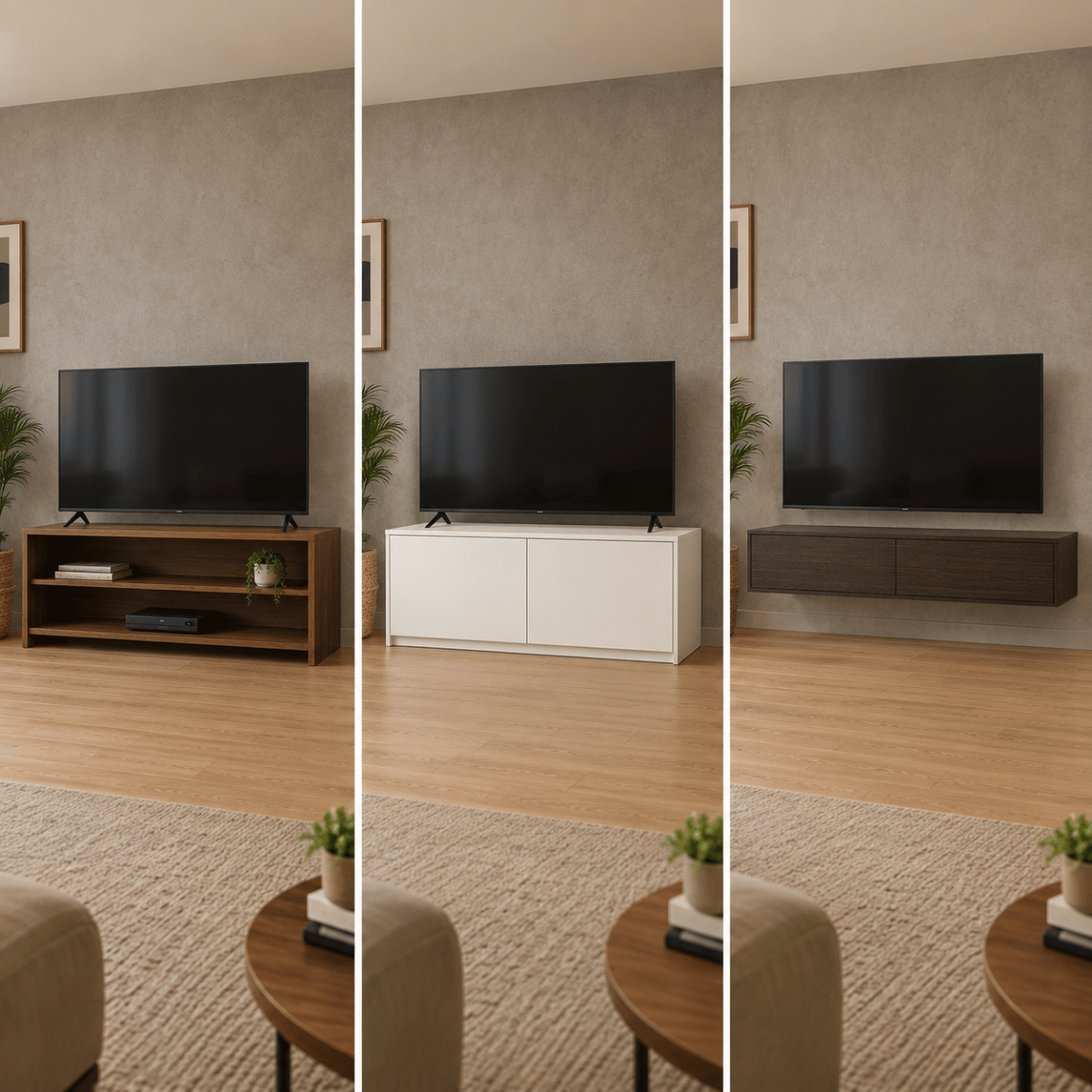
- A TV stand is an open-shelf unit; a TV cabinet has doors that close; a floating console is wall-mounted with no floor contact – these are structurally different, not interchangeable names
- A TV stand is the lowest cost and easiest to move – best for renters, people who rearrange often, and rooms where aesthetics matter less than budget
- A TV cabinet with doors is the right choice when cable clutter is the problem, when you have young children who touch devices, or when the living room is also a guest room
- A floating unit gives a clean, modern look but requires a solid load-bearing wall – do not install on drywall or hollow partition walls without professional anchoring
- TV unit width should be at least as wide as your TV – ideally 10-20 cm wider on each side
What is the difference between a TV stand and a TV cabinet?
The terms are used loosely in everyday speech but they describe structurally different pieces of furniture. Here is what each one actually is.
| Type | What it is | Storage | Best for | Approximate cost range |
|---|---|---|---|---|
| TV stand | Floor-standing unit with open shelves, no doors. TV sits on top. | Open shelves for devices, cables visible | Renters, budget buyers, frequently rearranged rooms | Rs 3,000 – Rs 12,000 |
| TV cabinet | Floor-standing unit with doors (shutter or sliding) that close over the storage section. TV sits on top or inside a cutout. | Hidden storage behind doors; can include drawers | Families with young children, cluttered cable setups, rooms used for multiple purposes | Rs 8,000 – Rs 35,000 |
| Floating / wall-mounted console | Mounted directly to the wall with brackets. No legs, no floor contact. | Open shelves or closed shutters, all wall-hung | Modern/minimalist interiors, rooms where floor space matters, solid load-bearing walls | Rs 6,000 – Rs 25,000 (plus installation) |
| Entertainment unit / media console | Wide, low floor unit that spans most of a wall. Combines open and closed storage sections. | Mix of open shelves, cabinets, and drawers | Large living rooms, home theatre setups, households with many devices and media | Rs 15,000 – Rs 60,000+ |
| Corner TV unit | Angled or L-shaped unit designed to sit in a room corner | Varies – open or closed depending on model | Small rooms where a corner is the only viable placement, or L-shaped living areas | Rs 4,000 – Rs 18,000 |
The most common source of confusion is the word “cabinet.” In everyday use, people say “TV cabinet” to mean any piece of furniture under the TV. In furniture terminology, a cabinet specifically has doors that close. If you want open shelves, you want a stand or a console – not a cabinet.
What is a floating TV unit?
A floating TV unit – also called a wall-mounted TV console – is a unit that attaches directly to the wall with brackets, leaving the floor completely clear underneath. From the front, it looks like it is suspended in mid-air. There are no legs and no visible support from below.
Floating units are popular for two reasons: they make a small room look larger (visible floor space reads as more space) and they are easier to clean underneath than floor-standing units. They also force a clean cable management approach because cables have to be routed up the wall or through a conduit, which removes the loose-cable-bundle problem by default.
The critical requirement: the wall must be solid and load-bearing. A standard floating TV unit with devices on it can weigh 15-30 kg. Indian homes with gypsum partition walls, false walls, or lightweight drywall partitions cannot safely support a wall-mounted console without specialist anchoring into studs or with toggle bolts rated for the load. If you are in a rental flat and cannot drill, a floating unit is not an option – go with a floor-standing stand or cabinet.
Which type of TV unit works best for your room size?
The type of TV unit that works is partly about room size and partly about what wall you have available. Here is a practical breakdown.
| Room size | Best unit type | Width to aim for | What to avoid |
|---|---|---|---|
| Small room (under 10×10 ft) | Compact floor stand or floating console | 90-120 cm | Wide entertainment units – they eat the only available floor path |
| Standard bedroom-sized living room (10×12 to 12×14 ft) | Floor stand or TV cabinet, 120-150 cm wide | 120-150 cm | Corner units (awkward viewing angles in rectangular rooms) |
| Medium living room (14×16 ft) | TV cabinet or floating console with shelves | 150-180 cm | Units under 120 cm – they look visually unanchored in a larger room |
| Large living room or open-plan (16 ft+) | Entertainment unit / media console that spans the wall | 180-250 cm | Small stands – they look out of scale and do not anchor the TV wall |
How to choose the right TV unit width
The TV unit width relative to the TV screen size is the most important measurement to get right. An undersized unit makes a large TV look like it is about to tip over. An oversized unit for a small TV looks empty and visually heavy.
The general rule: the TV unit should be equal to or wider than the TV itself, with 10-20 cm of unit extending beyond the TV on each side as the ideal. Here is how this translates by common TV sizes sold in India.
| TV screen size | TV physical width (approx.) | Recommended unit width |
|---|---|---|
| 32 inch | 72-76 cm | 90-110 cm minimum |
| 43 inch | 96-100 cm | 110-130 cm |
| 50 inch | 111-115 cm | 130-150 cm |
| 55 inch | 122-127 cm | 140-160 cm |
| 65 inch | 144-148 cm | 160-180 cm |
| 75 inch | 166-170 cm | 180-200 cm |
Beyond width, count your devices before buying. The average Indian living room has: one set-top box, one streaming dongle or smart stick, one router or OTT box, one gaming console or DVD player, and a soundbar. That is 4-5 devices with their own cables and remotes. A unit with only two open shelves will not hold all of these cleanly. Either go with a cabinet that hides the clutter or count the shelf positions before ordering.
Browse the Wakefit TV unit range for floor-standing, floating, and entertainment unit options in engineered wood. If you are also managing cable clutter, read the full guide on how to hide TV wires using a TV unit – the cable routing approach varies by unit type.
Which type of TV unit is best?
There is no single best type – the right answer depends on four things: whether you rent or own, how many devices you have, whether children can reach the unit, and what wall you have available. Here is a direct decision guide.
- You rent and cannot drill walls → floor-standing TV stand. No installation required, moves when you move.
- You have young children who touch devices and pull cables → TV cabinet with closing shutters. Doors create a physical barrier and hide the cable tangle.
- You want maximum floor space in a small flat → floating console on a solid brick wall. Frees up floor, easy to clean, modern look.
- You have a soundbar, gaming console, set-top box, streaming device, and router all in the same area → entertainment unit or TV cabinet with dedicated shelves. Open stands do not have enough organised storage for 5+ devices.
- You want a clean, minimal look and have solid walls → floating console with closed shutters. Best visual result when executed properly.
- Your TV is in a bedroom corner → corner TV unit. Angled viewing from the bed is more comfortable than a straight wall placement.
Frequently Asked Questions
1. What is the difference between a TV stand and a TV cabinet?
A TV stand has open shelves with no doors – devices and cables are visible. A TV cabinet has doors (sliding, hinged, or shutter-style) that close to hide everything stored inside. TV cabinets cost more and weigh more but give a cleaner look and protect devices from dust and children. TV stands are cheaper, lighter, and easier to move, but all cables and devices remain visible.
2. What is a floating TV stand?
A floating TV stand (more accurately called a floating TV console or wall-mounted TV unit) attaches directly to the wall with brackets, leaving the floor beneath it completely clear. It has no legs. The term “floating” refers to the visual effect of the unit appearing to hover above the floor. It requires a solid brick or concrete wall for safe installation – drywall and partition walls cannot support the load without specialist anchoring.
3. Which type of TV unit is best for a small room?
A floating console is the best type for a small room with solid walls because it keeps the floor visible and makes the room look larger. If the walls are hollow or drywall, a compact floor-standing TV stand (90-110 cm wide) is the practical alternative – it avoids the drilling requirement while keeping the footprint small. Avoid wide entertainment units in small rooms; they block floor paths and make the room feel cramped.
4. How wide should a TV unit be?
The TV unit should be at least as wide as the TV itself – ideally 10-20 cm wider on each side. For a 43-inch TV (approximately 100 cm wide), the unit should be 120-140 cm wide. For a 55-inch TV (approximately 125 cm wide), aim for 145-165 cm. A unit narrower than the TV looks unstable and creates a visual imbalance in the room.
5. Can you wall-mount a TV unit on drywall?
Not safely without specialist anchoring. Standard drywall or gypsum partition walls cannot hold the weight of a floating TV unit (15-30 kg including devices) with basic screws. If you want to mount on a partition wall, you need toggle bolts or cavity anchors rated for the total load, and ideally a professional to install them. The safest approach in a rental flat is a floor-standing unit that requires no drilling at all.
6. What is an entertainment unit and how is it different from a TV stand?
An entertainment unit (also called a media console) is a wide, low unit that spans most of a wall and typically includes a mix of open shelves, closed cabinets, and drawers. A TV stand is smaller, has only open shelves, and typically holds just the TV and 1-2 devices. Entertainment units are for large living rooms and home theatre setups with many devices, media collections, and storage needs. A TV stand is the simpler, more portable option for everyday use.
7. What height should a TV unit be?
The correct height places the centre of the TV screen at eye level when you are seated. The average seated eye level in India is 95-105 cm from the floor. Most floor-standing TV units are 40-55 cm tall, which places a 43-55 inch TV (adding the TV height of 60-75 cm) at roughly 100-115 cm to the screen centre – within the comfortable viewing range. If your sofa is unusually high or low, adjust by 5-10 cm accordingly. Floating units can be set at any height during installation, which is one of their advantages.
8. Is wood or metal better for a TV unit?
Engineered wood (MDF or particle board with a laminate finish) is the most common and practical material for TV units in India. It holds weight well, resists warping better than solid wood in humid conditions, and is significantly cheaper than solid wood while looking similar. Metal-frame TV stands with glass or wood shelves are a good modern option for lighter storage needs but are less suitable for heavy device setups. Avoid pure particle board (the lowest-cost option) for units that will hold more than 20-25 kg in total load.