
The words sofa and couch get used as synonyms in India but they describe pieces with meaningfully different depths, seat heights, and back angles – which is why the one that looked perfect in the showroom can feel wrong after two weeks at home. Beyond that, most sofa buyers in India pick a style by how it looks in photos, then discover it is 20 cm deeper than the living room wall allows, or that the L-shaped version they ordered does not leave enough clearance to open the balcony door. This guide covers every common sofa type available in India, what each is correctly called, the standard dimensions for Indian apartments, and which style works for which room size and shape.
Key takeaways
- A sofa is upright with a higher back and firmer cushions; a couch is lower, deeper, and designed for lying down – in Indian usage the words are interchangeable, but structurally they are different
- A two-seater sofa is formally called a loveseat – standard dimensions are 130-150 cm wide x 85-90 cm deep
- Standard 3-seater sofa dimensions for Indian homes: 175-200 cm wide x 85-90 cm deep x 80-90 cm tall
- L-shaped sofas need at least 3.5 m x 3.5 m of room to leave proper walkway clearance on all sides
- Seat depth matters as much as width: a 90 cm seat depth is comfortable for taller adults; a 60-70 cm seat depth is better for shorter users who would otherwise sit with their legs dangling
Is it a couch or a sofa? The actual difference
In everyday Indian usage, sofa and couch mean the same thing – the large upholstered seating in the living room. Technically, they describe different pieces.
A sofa is designed for sitting upright. It has a higher, straighter back (typically 80-90 cm total height), firmer seat cushions, and a shallower seat depth (65-80 cm) that encourages an upright seated posture. Sofas are considered the formal option – they look structured and defined.
A couch is designed for lounging. It has a lower, more reclined back, softer cushions, and a deeper seat (85-100 cm) that invites you to sink in or lie across it. The word comes from the French “couche” meaning to lie down. Couches are considered the relaxed, casual option.
In Indian homes, the “sofa set” in the drawing room is typically a sofa in the technical sense – structured, upright, formal. The piece in a media room or bedroom where people watch TV lying sideways is technically a couch. Most furniture brands in India label both as sofas, so the distinction is more useful for choosing the right feel than for shopping.
What are the types of sofas in India?
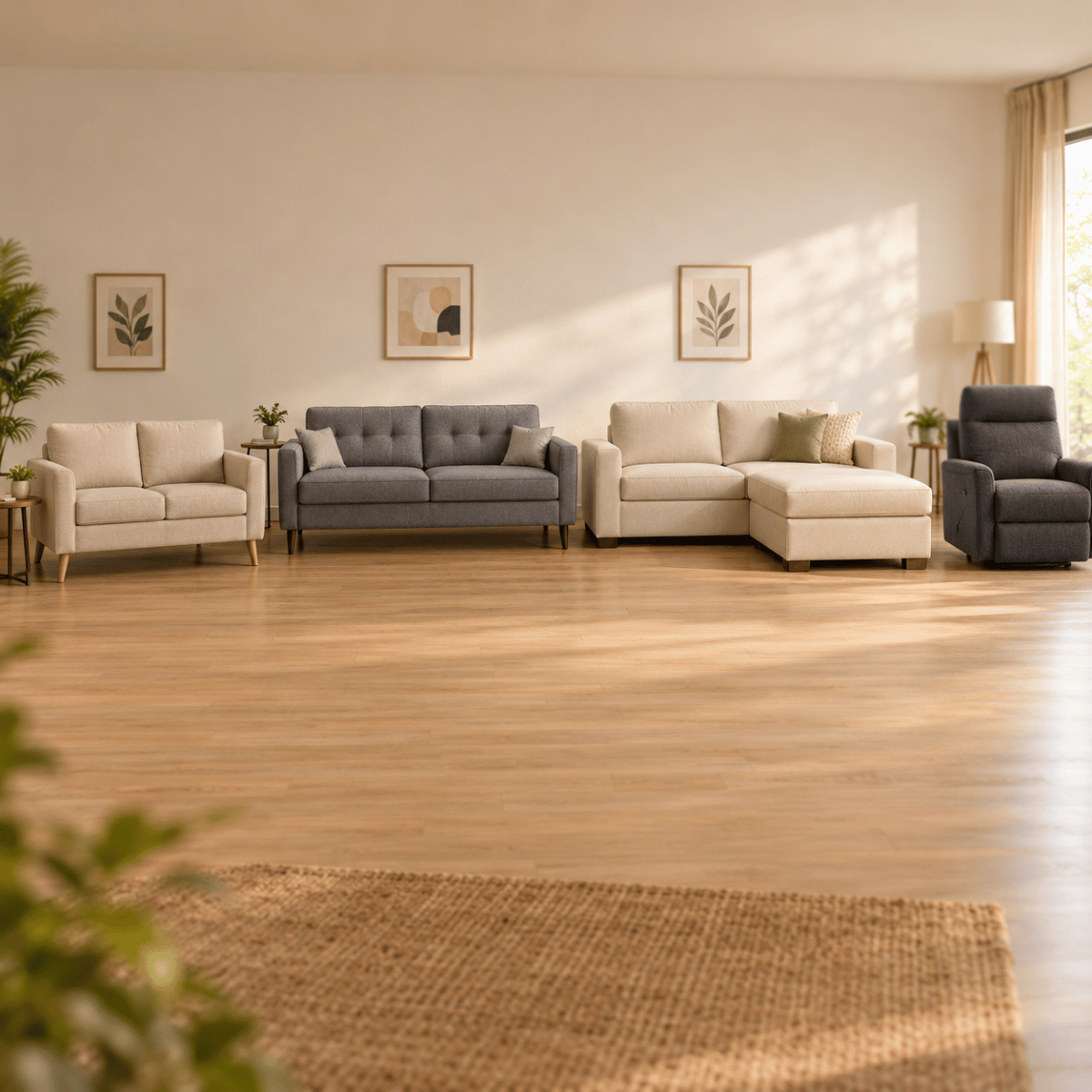
Seven types account for nearly all sofas sold in Indian homes. Here is what each is, what it is used for, and what to expect in terms of price and footprint.
| Type | What it is | Best for | Common footprint | Indian context |
|---|---|---|---|---|
| 3-seater sofa | The standard sofa seating three adults side by side on a single frame | Main seating in a living room; standard family use | 175-200 cm wide x 85-90 cm deep | The default choice for most Indian 2BHK living rooms; most sofa sets include one 3-seater + two 1-seaters |
| 2-seater / loveseat | A shorter sofa seating two adults; formally called a loveseat in Western furniture terminology | Smaller rooms; secondary seating alongside a 3-seater; studio apartments | 130-150 cm wide x 85-90 cm deep | Sold as part of sofa sets or as standalone; common in 1BHK flats where a 3-seater is too wide |
| L-shaped / sectional | An L-shaped sofa with a long main section and a shorter return arm, making a corner configuration | Large living rooms; open-plan layouts; households that spend significant time on the sofa | 240-270 cm on the long arm; 150-180 cm on the short arm | Popular in 3BHK and larger flats; the most common complaint is ordering without measuring – the L does not always fit the room corner |
| Sofa-cum-bed / sleeper sofa | A sofa that converts to a bed, either by folding out a hidden mattress or by reclining the back flat | Guest rooms; studio apartments where the same space serves as sitting and sleeping | 180-200 cm wide x 85-95 cm deep (sofa mode); extends to 180-200 cm in bed mode | Useful in Indian homes where a dedicated guest room is not practical; quality varies significantly – check the mattress thickness before buying |
| Recliner sofa | A sofa with individually motorised or lever-operated reclining backrests and footrests for each seat | Media rooms; households where one or two members spend extended time watching TV | 200-280 cm wide x 90-100 cm deep (sitting); adds 30-40 cm in depth when fully reclined | Requires 40-50 cm of clearance behind the sofa for the backrest to recline – cannot be placed directly against a wall |
| Chesterfield | A classic sofa with a distinctive deep-tufted or button-tufted upholstery, rolled arms at the same height as the back, and a formal, structured silhouette | Formal living rooms; interiors with a traditional, vintage, or colonial aesthetic | 180-210 cm wide x 85-95 cm deep | Less common in mass-market Indian homes but popular in premium and heritage-style interiors |
| Scandinavian / mid-century modern | A low-profile sofa with tapered wooden legs, a lower seat height (38-42 cm), and clean straight lines with minimal ornamentation | Modern, minimal Indian interiors; smaller flats where a low-profile sofa makes the room feel taller | 175-200 cm wide x 75-85 cm deep | The tapered legs make it easy to clean underneath – a practical advantage in Indian households; the lower seat height is less comfortable for older family members |
What is a two-seater sofa called?
A two-seater sofa is formally called a loveseat. The term originated in 18th-century England to describe a small sofa built for two – close enough that the seated pair could speak quietly. The name has nothing to do with romantic use; it simply refers to the size. In Indian furniture stores, you will see it listed as “2-seater sofa”, “loveseat”, or “settee” (a slightly more upright, formal version of the same form factor).
Loveseat dimensions in India: typically 130-150 cm wide x 85-90 cm deep x 80-88 cm tall, with a seat height of 42-46 cm. The 130 cm width is the minimum for two adults to sit without touching shoulders; 150 cm gives comfortable elbow room for both seated people.
Standard sofa dimensions for Indian homes
Indian apartments run smaller than the international standard, and most sofa dimensions published by international brands are calibrated for larger Western rooms. Here are the dimensions that work for standard Indian floor plans.
| Sofa type | Width (cm) | Width (inches) | Depth (cm) | Depth (inches) | Total height (cm) | Seat height (cm) |
|---|---|---|---|---|---|---|
| 1-seater / armchair | 75-90 | 30-35 | 80-90 | 31-35 | 80-90 | 42-46 |
| 2-seater / loveseat | 130-150 | 51-59 | 85-90 | 33-35 | 80-90 | 42-46 |
| 3-seater (standard) | 175-200 | 69-79 | 85-90 | 33-35 | 80-90 | 42-46 |
| L-shaped (small) | 200-240 long arm; 140-160 short arm | 79-94; 55-63 | 85-90 per arm | 33-35 | 80-90 | 42-46 |
| L-shaped (large) | 250-280 long arm; 160-200 short arm | 98-110; 63-79 | 90-100 per arm | 35-39 | 80-90 | 42-46 |
| Recliner (per seat) | 85-100 per seat | 33-39 | 90-100 (sitting); 120-140 (reclined) | 35-39; 47-55 | 95-105 | 42-48 |
One dimension most buyers ignore: seat depth. A 90 cm seat depth (the distance from the front of the seat cushion to the back cushion) suits taller adults who can sit with their back against the cushion and their feet flat on the floor. For shorter adults – common in Indian families – a 90 cm depth means either sitting with the back unsupported or with legs dangling. A 70-75 cm seat depth is often more comfortable for average Indian body proportions.
Which sofa type works for your room size and shape?
The sofa needs to fit the room twice: once in footprint and once in clearance. Clearance means the 90 cm of walkway space that should exist between the sofa and the opposite wall, coffee table, or TV unit.
- Small living room (under 3 m x 3.5 m): a 2-seater loveseat or a compact 3-seater under 175 cm wide. Avoid L-shaped sofas – the two-arm footprint leaves no walkway in a small room. A Scandinavian-style sofa with tapered legs reads as lighter and keeps the visual floor space open.
- Standard living room (3 m x 4 m, typical Indian 2BHK): a 3-seater (175-190 cm) with two 1-seaters works as a classic set. An L-shaped sofa fits if the corner placement does not block the balcony or bedroom door – always check the door swing before ordering.
- Large living room (3.5 m x 5 m or open plan): an L-shaped sectional fills the corner and defines the seating zone in a large open-plan space. A 3-seater alone will look undersized and visually unanchored in a room this large.
- Long, narrow room: place a 3-seater along the longest wall and a loveseat perpendicular on the short side rather than an L-shaped sofa, which would block the room’s main walking path.
- Room with a TV on the opposite wall: the front edge of the sofa should be 2-2.5 m from the TV for a 43-55 inch screen. If the room does not allow this with a full-depth sofa (85-90 cm), consider a shallower sofa (70-75 cm) or moving the sofa closer without the coffee table.
Browse the Wakefit sofa range for 2, 3, and L-shaped options in fabric and leatherette. If you are also planning the complete living room layout around the sofa, the guide on 7 sofa buying mistakes most Indians make covers the most common errors before the order is placed.
Frequently Asked Questions
1. What are the types of sofas?
The main types of sofas sold in India are: 3-seater sofa, 2-seater sofa (loveseat), L-shaped or sectional sofa, sofa-cum-bed, recliner sofa, Chesterfield, and Scandinavian or mid-century modern sofa. The 3-seater is the most common in Indian living rooms. L-shaped sofas are popular in larger 3BHK flats. Sofa-cum-beds are common in 1BHK apartments and guest room setups.
2. What is a two-seater sofa called?
A two-seater sofa is formally called a loveseat. In Indian furniture stores it is also listed as “2-seater sofa” or “settee”. Standard loveseat dimensions are 130-150 cm wide x 85-90 cm deep x 80-88 cm tall. The 130 cm width is the minimum for two adults; 150 cm gives comfortable elbow room. Seat height is typically 42-46 cm.
3. Is it a couch or a sofa?
In Indian everyday use, sofa and couch mean the same thing. Technically, a sofa is upright with a higher back and firmer cushions designed for sitting, while a couch is lower, deeper, and softer – designed for lounging or lying down. Most pieces sold in Indian furniture stores are sofas in the technical sense. In common usage in India, calling it a couch or a sofa is both correct.
4. What is the standard size of a 3-seater sofa in India?
A standard 3-seater sofa in India is 175-200 cm wide x 85-90 cm deep x 80-90 cm tall. The most common size is 180 cm x 85 cm. Seat height is 42-46 cm. For the sofa to fit comfortably in a room, leave at least 90 cm of walkway between the front edge of the sofa and the coffee table or TV unit, and 45-60 cm on the sides between the sofa arm and the nearest wall.
5. What size room do you need for an L-shaped sofa?
A small L-shaped sofa (200 cm x 150 cm) needs a minimum room size of approximately 3.5 m x 3.0 m to leave 90 cm of walkway clearance on the open sides. A large L-shaped sofa (270 cm x 180 cm) needs at least 4.0 m x 3.5 m. Always measure the room corner where the sofa will sit, check that the L configuration does not block any door swing, and verify delivery access – L-shaped sofas often cannot turn through narrow stairwells or doorways.
6. What is the difference between a sofa set and a sectional sofa?
A sofa set is a collection of separate pieces – typically one 3-seater, two 1-seaters, and sometimes a 2-seater – sold together as a matching group. Each piece is independent and can be rearranged. A sectional sofa (also called an L-shaped sofa) is a single connected configuration where the sections attach to each other and stay in one arrangement. Sofa sets offer more flexibility in small rooms; sectionals give a unified, larger seating area.
7. What sofa depth is comfortable for Indian body proportions?
A seat depth of 70-80 cm is generally more comfortable for average Indian body proportions than the international standard of 85-95 cm. A seat that is too deep forces shorter users to either sit with the back unsupported or with their knees bent and legs dangling. When testing a sofa in a showroom, sit normally and check that your back reaches the back cushion while your feet rest flat on the floor – if they do not, the sofa is too deep for you.
8. Can you put an L-shaped sofa in a small room?
Only if the room is genuinely square (not narrow) and the total room dimensions are at least 3.5 m x 3.0 m after the sofa footprint is placed. In most small Indian rooms under 3 m x 3.5 m, an L-shaped sofa blocks walkways and makes the room feel cramped. A better option for small rooms is a 2-seater loveseat plus a 1-seater armchair, which gives 3-person seating in a much smaller footprint and is easier to rearrange when needed.