
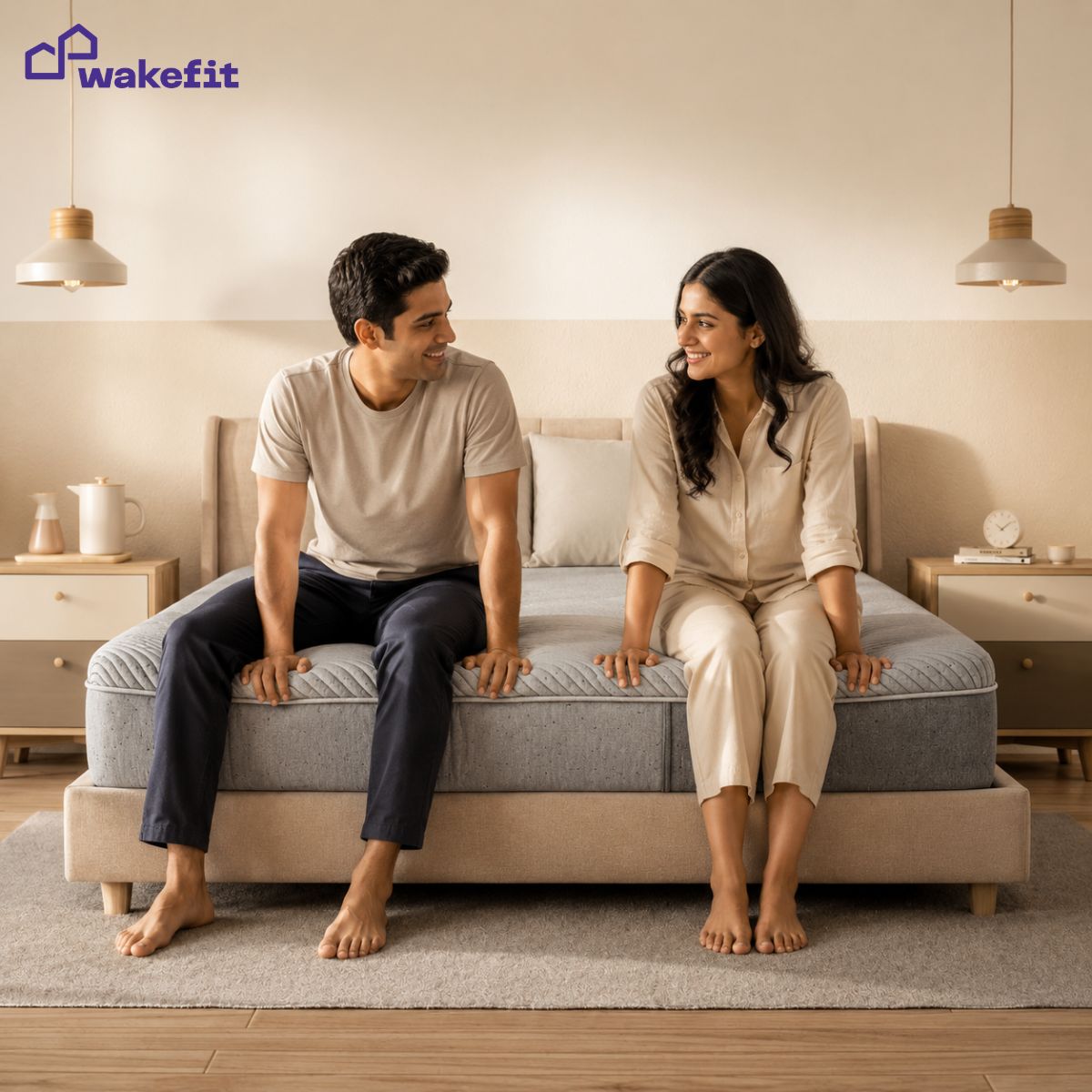

Choosing the best mattress for couples involves solving two problems that most mattress guides treat as one. Motion transfer – feeling your partner turn over at 2am – is a mechanical problem with a clear solution based on mattress construction. Mismatched firmness – one partner wants firm, the other wants soft – is a biomechanical compromise that depends on body weight and sleep position. Treating them as the same problem leads to mattresses that fix one and make the other worse. This guide separates them, gives you the exact specifications for each, and shows where the two solutions overlap.
Key takeaways
- Motion transfer and mismatched firmness are two separate problems – confusing them leads to the wrong mattress choice
- Pocket spring and memory foam offer the best motion isolation; Bonnell spring is the worst
- For mismatched firmness, the compromise zone is medium-firm (ILD 28-34) – it works across most sleep positions and weight combinations
- When the weight difference between partners exceeds 30 kg, a standard compromise mattress may not work – a zoned or dual-comfort mattress is the better solution
- Edge support is an underrated couples feature – it prevents the lighter partner from rolling toward the heavier partner’s side during the night
What is motion transfer and why does it disturb sleep more than couples realise?
Motion transfer is the transmission of movement from one side of the mattress to the other. When one partner turns over, sits up, or gets out of bed, the energy travels through the mattress material and reaches the other side as a perceptible vibration or shift. On a mattress with poor motion isolation, this can happen 10-15 times per night – most of them too brief to remember but long enough to push the lighter sleeper out of deep sleep stages repeatedly.
The effect is cumulative. A partner who “doesn’t remember being disturbed” may still be getting significantly less deep sleep than they would on a mattress with better motion isolation. The sign is waking up tired without a clear reason, or one partner consistently reporting better sleep quality than the other.
Which mattress types isolate motion best – and which are the worst offenders?
| Mattress Type | Motion Isolation | Why | Trade-off |
|---|---|---|---|
| Memory foam (high-density) | Excellent | Viscoelastic material absorbs and localises movement – energy doesn’t travel laterally through the foam | Retains heat; can feel “stuck” when repositioning; not ideal for stomach sleepers |
| Latex | Very good | Responsive but dense – movement doesn’t propagate across the surface the way spring systems do | Higher cost; some bouncy feel that slightly reduces isolation vs memory foam |
| Pocket spring | Good | Each coil is individually wrapped and works independently – a spring compressed on one side doesn’t pull adjacent springs down | More bounce than foam; motion isolation depends on coil count (higher = better) |
| High-density PU foam (firm) | Good | Dense foam doesn’t transmit vibration easily; not as absorptive as memory foam but significantly better than spring systems | Less contouring than memory foam; not ideal for side sleepers needing pressure relief |
| Bonnell spring (open coil) | Poor | All coils are connected in a continuous system – a spring on one side directly pulls the springs on the other side | The most widely sold spring type in India is also the worst for couples |
| Soft foam or pillow-top | Moderate | Soft top layer absorbs some surface movement but the compression it allows creates a valley effect when one partner is heavier | The valley effect causes the lighter partner to roll toward the heavier one during the night – a separate problem from motion transfer |
The valley effect in soft mattresses is worth separating from motion transfer because couples often conflate them. It is not vibration – it is a slow gravitational pull toward the deeper impression left by the heavier partner. The solution for the valley effect is firmness and edge support, not motion isolation. A mattress can have excellent motion isolation and still have a valley effect if it is too soft for the heavier partner’s weight.
What firmness works when two people have different preferences?
Firmness preference is not arbitrary. It is almost always driven by body weight and sleep position – and those factors are objective. The table below shows the compromise ILD zone for the most common partner combinations.
| Partner A | Partner B | Compromise Zone | Notes |
|---|---|---|---|
| Side sleeper, under 65 kg | Back sleeper, under 75 kg | Medium-firm, ILD 28-33 | Both positions work well here; this is the most compatible pairing |
| Side sleeper, under 65 kg | Stomach sleeper, 60-80 kg | Medium-firm, ILD 30-35 | The stomach sleeper’s hip-sinking requirement pulls firmness slightly higher |
| Side sleeper, under 60 kg | Stomach sleeper, above 80 kg | Difficult – ILD 32-38 is needed for stomach sleeper but may feel hard for light side sleeper | Consider a zoned mattress or dual-comfort option |
| Back sleeper, 70-90 kg | Back sleeper, 70-90 kg | Medium-firm, ILD 28-35 | Easiest pairing to find; most mattresses in this range work well |
| Side sleeper, 70+ kg | Side sleeper, 70+ kg | Medium, ILD 25-32 | Both need pressure relief at shoulder and hip; go softer rather than firmer |
| Any position, above 90 kg | Any position, below 60 kg | Weight differential too large for a single compromise | This combination needs a zoned or dual-comfort mattress – see below |
When is a single mattress not enough – and what are the alternatives?
When the weight difference between partners exceeds roughly 30 kg, the ILD requirements for each partner diverge beyond what a single uniform-firmness mattress can bridge. The heavier partner needs enough resistance to prevent hip or lumbar sinking; the lighter partner at the same ILD will feel the mattress as uncomfortably hard. This is when a different approach is needed.
Zoned mattresses have different firmness levels across different zones of the same surface – typically firmer in the hip and lumbar area, slightly softer at the shoulder. This helps different body weights on the same surface because each person’s heaviest contact point meets more resistance while the lighter contact points find more give. Zoned mattresses are more expensive than standard foam mattresses but are the most practical single-mattress solution for couples with significant weight or position differences.
Dual-comfort mattresses are constructed with two different firmness zones side by side – firm on one half, medium or soft on the other. Each partner sleeps on their preferred firmness. The trade-off is that the centre join can be felt if either partner sleeps near the middle, and motion isolation across the join is typically lower than within each zone.
Split mattresses are two separate mattresses placed side by side in a shared bed frame. Each partner gets their optimal firmness with zero compromise. The practical downsides are the visible and palpable gap between mattresses, and the need to either use two separate fitted sheets or a mattress bridge pad to cover the gap.
Why does edge support matter specifically for couples?
Edge support is rarely listed as a couples feature, but it is one of the most relevant. On a mattress without reinforced edges, the sleeping surface effectively narrows – the perimeter is softer and less supportive, which means neither partner comfortably uses the outer 10-15 cm of the mattress. On a standard queen mattress (160 cm wide), this reduces the usable width to roughly 130 cm.
The second effect is more directly disruptive: without edge support, a lighter partner near the edge of the mattress gets a gradual gravitational pull toward the centre as the edge compresses more than the middle. They either migrate toward their partner during the night or wake up and correct their position – both outcomes disturb sleep. A mattress with reinforced edge support maintains a consistent surface across the full width, which is why it matters disproportionately more on a shared bed than a solo one.
Which Wakefit mattress works for couples?
For couples prioritising motion isolation, the Wakefit Orthopaedic Memory Foam Mattress uses a 72 kg/m3 high-density foam that provides excellent motion isolation – movement on one side does not propagate across the surface. The high-density base also resists the valley effect that softer mattresses develop under weight differentials over time. For couples in the medium weight range (both partners 60-85 kg) with different position preferences, the medium-firm configuration sits in the compromise zone that works across back, side, and stomach combinations.
For couples with a significant weight difference or strong firmness disagreement, browse the full Wakefit mattress range filtered by firmness – the zoned and dual-comfort options are listed there. All Wakefit mattresses come with a 100-night free trial, which is the most practical way to test whether a specific firmness compromise actually works for both partners in real sleep conditions rather than a showroom.
Frequently Asked Questions
1. What type of mattress is best for couples to reduce motion transfer?
Memory foam offers the best motion isolation of any mattress type – its viscoelastic properties absorb and localise movement so it does not travel laterally across the surface. Pocket spring is the best option if you prefer a spring mattress – independently wrapped coils do not transmit force the way connected Bonnell coils do. Avoid Bonnell or open-coil spring mattresses if motion transfer is a priority, as all coils in those systems are mechanically linked.
2. My partner and I prefer different firmness levels. What should we do?
Start with a medium-firm mattress (ILD 28-34) – this is the compromise zone that works for the widest range of sleep positions and body weights. If the weight difference between you and your partner exceeds 30 kg, or if one of you is a strict stomach sleeper and the other a side sleeper, a standard compromise mattress may not satisfy either of you. In that case, a zoned mattress (different firmness by zone) or a dual-comfort mattress (different firmness on each half) is the more practical solution.
3. Is a queen or king mattress better for couples in India?
A queen mattress (typically 160 x 200 cm in India) is the standard choice for couples – it provides enough width for two adults to sleep without disturbing each other in most bedroom sizes. A king mattress (180 x 200 cm) adds 20 cm of width, which is meaningful if either partner is a restless sleeper or if motion transfer is a concern – more distance between sleep zones reduces the perceived intensity of movement. King size is worth considering if your bedroom can accommodate it, but a queen with a good motion-isolating mattress (memory foam or pocket spring) solves most couples’ sleep issues without the footprint.
4. Can a memory foam mattress cause partners to roll toward each other?
Yes, if the density is insufficient for the heavier partner’s weight. When one partner creates a deeper impression in the foam than the other, the surface slopes toward the heavier partner’s side – the valley effect. High-density memory foam (65+ kg/m3) resists this significantly. Standard density foam (30-45 kg/m3) is more prone to it. The solution is choosing a high-density foam in the appropriate firmness for the heavier partner’s weight, not switching mattress types entirely.
5. Does mattress size affect motion transfer?
Yes, indirectly. A larger mattress puts more distance between the two partners’ sleep zones, which means the same amount of energy transferred through the material reaches the other person with lower intensity. On a queen mattress, both partners typically sleep 60-70 cm apart (centre to centre). On a king, this increases to 80-90 cm. This distance reduction in perceived motion transfer is modest but measurable – mattress material choice has a much larger effect than size alone.
6. My partner gets up early every morning and wakes me up. What type of mattress helps?
This is a motion transfer problem with a predictable pattern – and memory foam is the most effective solution. Memory foam absorbs the compression and release of getting up rather than bouncing it across the surface. Pocket spring also helps but has more rebound. What also matters is edge support: if the mattress edge compresses significantly when your partner sits up to get out of bed, that compression is transmitted as a shift across the surface. A mattress with reinforced edges reduces this specific disturbance significantly.
7. Is latex or memory foam better for couples?
Both are excellent for couples, for slightly different reasons. Memory foam has marginally better motion isolation because it absorbs and holds the impression of movement rather than rebounding. Latex has better temperature regulation – it sleeps cooler than memory foam, which matters in Indian summers particularly in non-AC rooms. If heat retention is not a concern, memory foam edges out latex for motion isolation. If both partners tend to sleep hot, latex is the better choice even if motion isolation is the primary goal.
8. How do we choose a mattress if one of us hasn’t found a comfortable firmness yet?
Use the 100-night trial period that most reputable Indian mattress brands offer, including Wakefit. Start with medium-firm (ILD 28-34) as it is the most forgiving choice across different sleep positions and body weights. Sleep on it for at least 30 nights before forming a verdict – the body takes 2-3 weeks to adjust from a previous mattress and early discomfort is often transition discomfort rather than a firmness mismatch. If after 30 nights one partner still finds it consistently too firm or too soft, use that data to inform the next choice rather than guessing upfront.



No Comments