
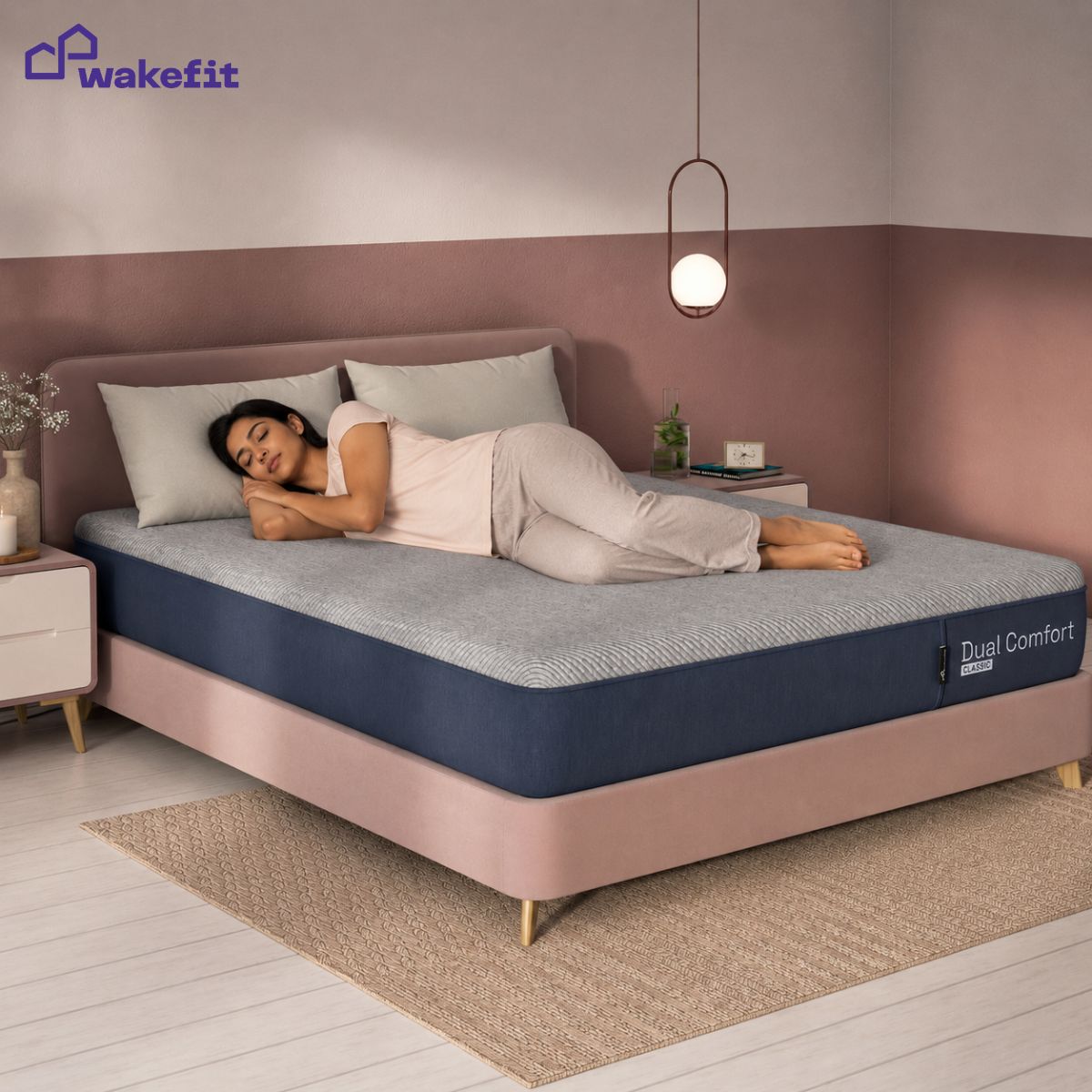

Side sleeping is the most common sleep position in India – but it puts your full body weight through a contact area roughly 60% smaller than back sleeping, concentrated at the shoulder and hip. Get the wrong mattress and you wake up with shoulder numbness, hip aches, or a lower back that takes 20 minutes to straighten out. This guide gives you the exact firmness range, foam density, and material to look for based on your body weight, so you can filter correctly before spending Rs 20,000+.
Key takeaways
- Side sleepers need medium-soft to medium firmness (ILD 18-35) – firm mattresses cause shoulder and hip pressure; very soft ones fail to support the waist
- Body weight changes the right ILD: under 60 kg needs ILD 18-25; 60-90 kg needs ILD 25-35; over 90 kg needs ILD 32-40
- Foam density (kg/m3) determines how long pressure relief lasts – look for 60 kg/m3 or above; budget foam at 35-40 kg/m3 compresses within 2-3 years
- Memory foam gives better pressure relief; latex is cooler and lasts longer – in non-AC rooms in Indian summers, latex wins
- The most common mistake: buying a uniformly firm orthopaedic mattress that prevents the shoulder from sinking, creating exactly the pressure it should relieve
Why does your sleep position change what your mattress needs to do?
Side sleeping concentrates body weight at two narrow points: the shoulder takes roughly 25% of total body weight, and the hip takes 40-45%. On a mattress that is too firm, neither sinks adequately – the shoulder compresses the brachial nerve network (causing the arm-numbness most side sleepers know) and the hip develops localized pressure that interrupts circulation. On a mattress that is too soft, both sink too deeply, pulling the waist down and creating a lateral spinal curve that causes lower back pain by morning.
The right mattress does two things simultaneously: it allows the shoulder and hip to sink (cushioning pressure) while keeping the waist supported (maintaining spinal alignment). That requires a specific firmness range and a material that contours rather than simply compresses under load.
There is also a rotational element most guides ignore. In side position, your top shoulder rotates forward and your top hip rotates backward. A mattress that does not let the bottom shoulder sink forces this rotation into the neck and lumbar spine instead – a slow-accumulating stress that shows up as stiffness after months, not days.
What firmness level do side sleepers need – and does body weight change that?
Firmness is measured in ILD (Indentation Load Deflection) – the force in pounds required to compress foam by 25%. A lower ILD means softer foam. Body weight changes how deeply you sink into a given ILD, which is why the same mattress feels firm to a 55 kg person and too soft to a 90 kg person.
| Body Weight | Recommended Firmness | ILD Range | Why |
|---|---|---|---|
| Under 60 kg | Soft to medium-soft | ILD 18-25 | Lighter body does not generate enough pressure to compress firmer foam – shoulder and hip will not sink adequately |
| 60-80 kg | Medium | ILD 25-32 | Most common range – balances pressure relief at the shoulder and hip with waist support |
| 80-100 kg | Medium-firm | ILD 32-40 | Heavier body sinks too deeply in softer foam, losing lumbar support – needs more resistance |
| Over 100 kg | Firm with soft comfort layer | ILD 38-50 (base) | Standard soft mattresses bottom out under higher body weight; pressure relief requires a dense, firm base with a separate soft top layer |
Foam density (kg/m3) matters separately from firmness. Density determines how long the mattress maintains its ILD rating. A mattress at ILD 28 with 38 kg/m3 density compresses to ILD 22 within 2-3 years, losing its support. The same ILD 28 at 65 kg/m3 density holds its rating for 8-10 years. For side sleepers who depend on specific pressure relief, density is not a luxury spec – it determines whether the mattress still works in year four.
Which mattress material works best for side sleepers in India?
Three materials work well for side sleeping. The right one depends on your room temperature, budget, and whether you prioritise pressure relief or durability.
| Material | Pressure Relief | Heat (Non-AC Room) | Lifespan | Price Range (Queen) | Best For |
|---|---|---|---|---|---|
| Memory foam | Excellent – contours fully | High – traps heat | 7-10 years at 60+ kg/m3 | Rs 12,000-30,000 | AC rooms, pure pressure relief priority |
| Latex | Very good – responsive | Low – naturally breathable | 10-15 years | Rs 18,000-50,000 | Non-AC rooms, hot sleepers, back pain |
| Hybrid (foam + pocket springs) | Good – zoned coils help | Medium – coils improve airflow | 8-12 years | Rs 20,000-45,000 | Side-back combination sleepers, couples |
| Standard PU foam | Poor – compresses unevenly | Medium | 3-5 years | Rs 5,000-15,000 | Not recommended for side sleepers |
Memory foam contours to the exact shape of your shoulder and hip, distributing weight across the widest surface area possible. This is why it dominates side sleeper recommendations globally. The India-specific issue: standard memory foam is one of the worst materials for non-AC bedrooms from April to September. Gel-infused or open-cell memory foam reduces heat retention partially, but no memory foam variant runs as cool as latex.
Latex is the better choice for side sleepers in non-AC rooms – naturally breathable, does not trap body heat, and lasts 10-15 years with consistent support. It has a responsive feel (pushes back against pressure) rather than a cradling one, which some side sleepers prefer for the feeling of control during position changes. Natural latex from reputable sources carries Oeko-Tex or GOLS certification – worth checking before buying.
Hybrid mattresses combine pocket coils for airflow and motion separation with a foam or latex comfort layer for pressure relief. The better option for couples where one partner is a side sleeper and the other is not – pocket coils compress independently, so the side sleeper’s deeper sink does not transfer across the bed.
What are the two pressure points side sleepers need to protect?
Understanding why these two points matter helps you evaluate mattresses before buying – not just after 90 nights of poor sleep.
The shoulder. Your bottom shoulder is the primary pressure point in side position. It takes roughly 25% of body weight through a structurally narrow contact area – pressure per square centimetre is high. On a firm mattress, the shoulder compresses against the surface rather than sinking into it, putting the brachial plexus (the nerve bundle at the shoulder joint) under sustained pressure. This is the cause of arm numbness that wakes side sleepers in the night. The mattress needs to allow 4-6 cm of shoulder sink into the comfort layer. A thick, soft comfort layer (5-7 cm of ILD 18-25 foam) on top of a firmer support layer handles this correctly.
The hip. Your hip takes 40-45% of body weight in side position. On a mattress that is too soft, the hip sinks deeply enough to pull the lumbar spine into lateral flexion – lower back pain that gets misattributed to the mattress being “too old” when the real problem is the mattress being too soft. The support layer of the mattress needs to be firm enough to stop the hip at the right depth. Two-layer construction (soft comfort layer + firm support layer) is the engineering solution that handles both the shoulder and hip problem together.
What should side sleepers avoid when choosing a mattress?
Avoid uniformly firm orthopaedic mattresses (ILD 45+) without a soft comfort layer. The most common mistake in India. Many buyers associate “orthopaedic” with better for pain, but a uniformly firm mattress without a soft comfort layer prevents the shoulder and hip from sinking – it creates exactly the pressure problems side sleeping is prone to. An orthopaedic mattress for a side sleeper must have a soft comfort layer (ILD 18-28) on top of a firm support core. Not uniformly firm throughout.
Avoid foam density below 40 kg/m3. Budget mattresses at Rs 5,000-10,000 typically use 32-38 kg/m3 foam. This compresses unevenly within 18-36 months, creating dips at the shoulder contact point. The pressure relief benefit – the entire reason side sleepers choose memory foam – disappears before year three. A mattress with 60+ kg/m3 foam costs more upfront but costs less per year of functional sleep.
Avoid thick memory foam in non-AC rooms. An all-memory-foam mattress at 10-15 cm thickness in Chennai, Mumbai, or Bengaluru from April to September creates heat discomfort that interrupts sleep more than pressure point pain would. Choose a mattress with a latex or breathable coir layer if your bedroom is not climate-controlled for most of the year.
When the right mattress for a side sleeper is a high-density memory foam option, Wakefit’s Orthopaedic Memory Foam Mattress uses 72 kg/m3 foam – above the 60 kg/m3 threshold at which pressure relief holds for 8-10 years – with OEKO-TEX certification and a 100-night free trial so you can verify the firmness works for your body weight before committing. Browse the full mattress range to find the right ILD for your weight category.
Frequently Asked Questions
1. What firmness is best for side sleepers in India?
Medium-soft to medium (ILD 18-35 depending on body weight). Under 60 kg: ILD 18-25. Between 60-90 kg: ILD 25-35. Over 90 kg: ILD 32-40 with a soft comfort layer. Firmness must be matched to body weight – the same mattress that is perfect for a 65 kg side sleeper will feel too firm for a 55 kg one and too soft for an 85 kg one.
2. Is memory foam or latex better for side sleepers?
Memory foam offers better pressure relief through full contouring; latex is cooler and more durable. In AC rooms where heat is not a factor, memory foam is the stronger choice for side sleepers. In non-AC rooms or for hot sleepers in Indian summers, latex performs better year-round. Both work – the choice is driven by your room temperature and whether you find the cradling feel of memory foam or the responsive feel of latex more comfortable.
3. Can side sleepers use a firm mattress?
A uniformly firm mattress causes shoulder and hip pressure in side position – it does not allow adequate sinkage at the key contact points. However, a medium-firm support layer with a soft comfort layer (5-7 cm ILD 18-28) on top works well for heavier side sleepers (80+ kg). The support base can be firm; the comfort layer must be soft. Never uniformly firm throughout for a dedicated side sleeper.
4. Why does my shoulder hurt after sleeping on my side?
Two causes: the mattress is too firm (shoulder is not sinking enough, compressing the brachial nerve), or the pillow is the wrong height (forcing the neck to tilt and the shoulder to compensate). The palm-press test: press your hand flat on the mattress at shoulder level and release. If it rebounds in under 2 seconds with no visible indent, it is likely too firm for side sleeping. Pair any mattress adjustment with a pillow height check – both need to be correct together.
5. How long should a side sleeper mattress last?
High-density foam (60+ kg/m3) or latex: 8-10 years. Standard PU foam (35-40 kg/m3): 3-5 years. The first sign it needs replacement: shoulder or hip pain that was not present in the first year of use. Visible sagging of 3+ cm at the shoulder contact area is the structural confirmation. Side sleepers accelerate mattress wear at those contact points, which is why density is more important for side sleepers than for back sleepers.
6. Is sleeping on your side good for your back?
Yes, when the mattress is correct. Side sleeping maintains the natural spinal curve, reduces disc pressure versus lying flat on your back, and is recommended during pregnancy and for acid reflux. The back pain that side sleepers experience is a mattress problem (wrong firmness or density) or a pillow problem, not a position problem. Matching the mattress to body weight resolves it in most cases.
7. What pillow height do side sleepers need with a new mattress?
The pillow must fill the gap between the shoulder and the neck completely. For most Indian adults this is 10-15 cm of compressed height. Too thin and the neck tilts downward; too thick and it pushes upward – both create cervical strain. When switching to a new mattress (especially a softer one), your shoulder sinks deeper, which means you may need a slightly thinner pillow than before. Reassess pillow height any time you change mattress firmness.
8. Can side sleepers sleep on a spring mattress?
Open coil (Bonnell) spring mattresses are not recommended for side sleepers – the coils are interconnected, firmness is uniform rather than zoned, and motion transfers across the bed. Pocket spring or hybrid mattresses (independent pocket coils + foam comfort layer) work well because each coil compresses independently, allowing shoulder and hip sinkage without disturbing a partner. A pocket spring hybrid with a 5-7 cm memory foam comfort layer is a strong option for side sleepers who prefer a springy feel.


No Comments