
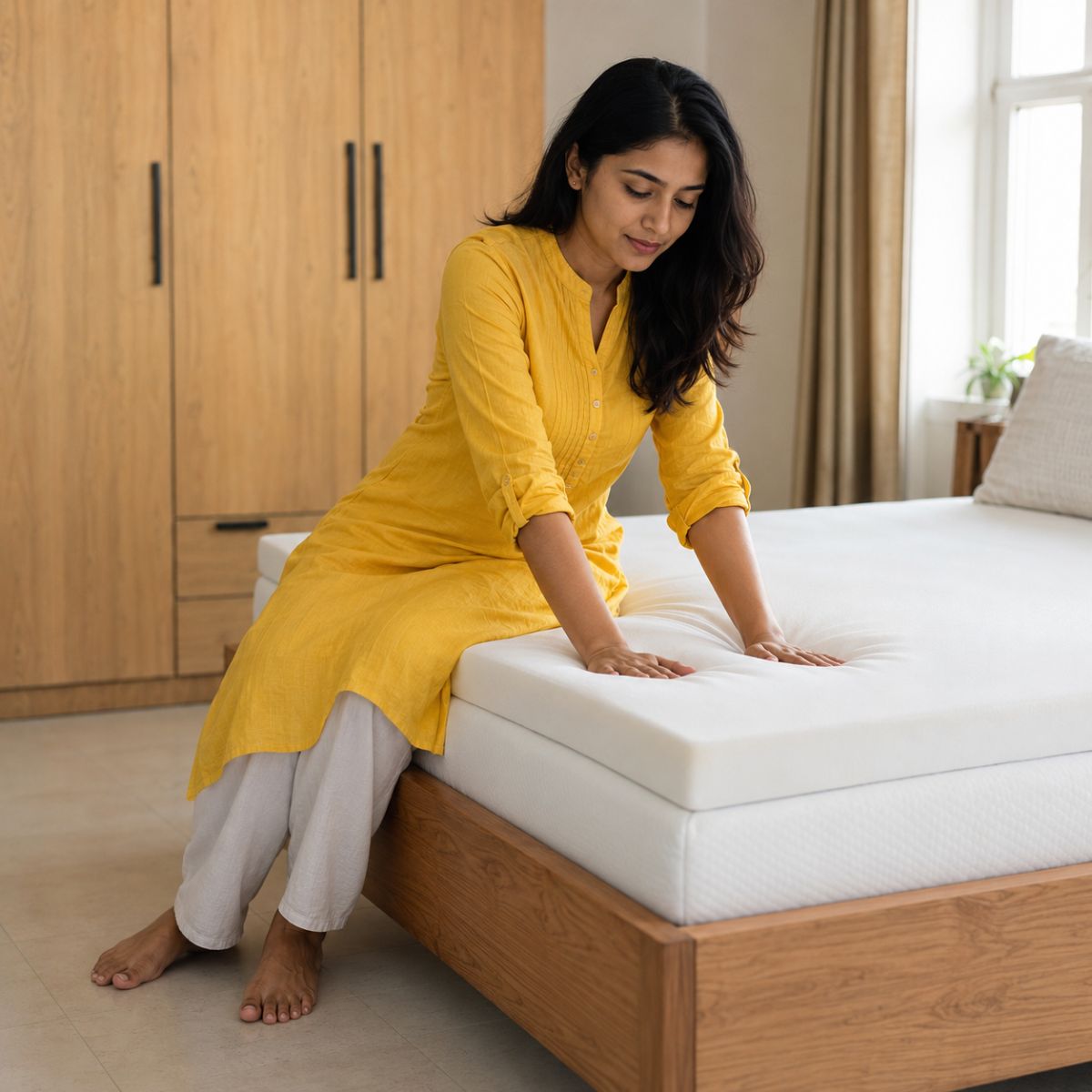

Your mattress feels too firm, you wake up with shoulder aches, and every ad you see is for a Rs 25,000 replacement you are not ready to commit to. A mattress topper – a 2-10 cm removable layer that sits directly on your existing mattress – costs Rs 3,000-8,000 and can transform the feel of a firm or mildly worn surface without replacing anything. But it does not work for every problem, and this guide tells you exactly when it does and when it does not.
Key takeaways
- A mattress topper is a removable 2-10 cm layer that changes how your existing mattress feels – without replacing it
- Memory foam and latex are the best types for back pain; fibre toppers are the budget pick for soft feel
- A topper works when your mattress is structurally sound but feels too firm – if there is sagging of 3+ cm, a topper will not fix it
- Toppers cost Rs 1,500-15,000 in India; latex lasts 5-7 years, memory foam 3-5 years
- If your mattress is over 8 years old with visible sagging, buy a new mattress – a topper will delay the problem and cost you more overall
What exactly is a mattress topper – and how is it different from a protector or pad?
A mattress topper is a standalone comfort layer, 2-10 cm thick, that lies on top of your mattress and is held in place by elastic corner straps or a fitted band. It changes the feel of the sleep surface significantly – this is not a cosmetic addition.
Three products get confused constantly:
| Product | Thickness | Purpose | Changes Sleep Feel? |
|---|---|---|---|
| Mattress protector | 0.1-0.5 cm | Waterproof barrier against spills and allergens | No |
| Mattress pad | 0.5-2 cm | Thin comfort layer with some stain protection | Slightly |
| Mattress topper | 2-10 cm | Significant comfort upgrade – changes firmness level | Yes, noticeably |
A protector protects. A pad adds a little softness. A topper actually changes how your mattress feels. If you are deciding between all three: a protector is non-negotiable for every mattress; a topper is the solution if the mattress itself feels wrong.
What types of mattress toppers are available in India – and which suits you?
There are four main types. Each suits a different problem and budget.
| Type | Price Range | Lifespan | Best For | Main Drawback |
|---|---|---|---|---|
| Memory foam | Rs 3,000-8,000 | 3-5 years | Pressure relief, side sleepers | Traps heat in non-AC rooms |
| Latex | Rs 6,000-15,000 | 5-7 years | Back pain, hot sleepers | Higher upfront cost |
| High-density foam | Rs 2,500-5,000 | 2-3 years | Budget firmness fix | Less contouring than memory foam |
| Fibre/microfibre | Rs 1,500-4,000 | 1-2 years | Soft feel, easy washing | Compresses quickly, no support |
Memory foam contours to your body shape and relieves pressure at the hips and shoulders – why it is the default recommendation for side sleepers. The drawback in India: it retains body heat. Without AC, a memory foam topper can feel uncomfortably warm from April through September in cities like Chennai and Bengaluru.
Latex is the most durable option and naturally cooler than memory foam. It pushes back against your body (responsive feel) rather than cradling it – better for back pain because it maintains spinal alignment without letting you sink. The higher price is offset by a 5-7 year lifespan.
High-density foam is the budget alternative to memory foam. Less contouring, but gets the job done for mild firmness issues. Fibre toppers feel soft but flatten within 12-18 months – fine for a guest room, not for a bed you sleep in every night.
What are the real benefits of using a mattress topper?
The main benefit is letting you change how a mattress feels without buying a new one. But toppers perform best in specific scenarios.
Firm mattress relief. A structurally sound mattress that feels too hard is exactly what a 5-7 cm memory foam or latex topper is designed for. You are solving a surface-feel problem, not a structural one – which means a topper actually works here.
Pressure point reduction. Side sleepers put concentrated weight on their hip and shoulder. A topper with an ILD (Indentation Load Deflection) rating of 20-28 (soft-medium) cushions these contact points, reducing numbness and position changes through the night. No competitor article mentions ILD – it is the spec that actually tells you how firm a foam topper is.
Temperature regulation. Latex and fibre toppers are breathable. If your current mattress sleeps warm, a latex topper can noticeably lower the perceived surface temperature – an important consideration across most of India for 6-8 months of the year.
Motion isolation for couples. Memory foam absorbs movement. If one partner’s turning disturbs the other, a memory foam topper reduces transferred motion even if the mattress underneath is a spring type – a cheaper fix than replacing to a pocket spring mattress.
When does a mattress topper fix your problem – and when does it make things worse?
This is the question no other blog answers clearly. Here is the honest picture.
A topper works when your mattress is structurally sound but the surface feel is wrong. The test: press your palm flat on the mattress and release. If it rebounds in 2-3 seconds without leaving a visible dip, the structure is intact and a firmness-only problem is exactly what a topper solves.
| Problem | Visible Sign | Right Fix |
|---|---|---|
| Structural sagging | Dip of 3+ cm when you lie down | New mattress – topper cannot fix this |
| Broken or bent springs | Creaking, uneven zones of support | New mattress |
| Mattress age 8+ years with issues | Multiple failing points | New mattress |
| Moisture damage | Musty smell, soft spots | New mattress |
| Surface firmness only | No visible dip, just feels hard | Topper works |
| Slight softening | 1-2 cm depression, otherwise even | Topper works |
A 5-7 cm topper on a sagging mattress creates a false surface – you sink through the topper into the dip underneath. The sag still reaches your spine. The topper masks the symptom and delays the replacement by 6-12 months, after which you will still need a new mattress but will have spent Rs 5,000 extra.
The 30-second spine check: lie on your mattress in your normal sleep position and have someone observe your spine from the side. If your lower back curves upward (gap between back and mattress) or sinks downward, the internal support has failed. That is a new mattress problem, not a topper problem.
Is a mattress topper worth the money – or should you just replace the mattress?
The ROI calculation is simple. A memory foam topper at Rs 4,000-5,000 lasting 3-5 years works out to Rs 800-1,700 per year. A quality mattress at Rs 20,000-25,000 lasting 8-10 years works out to Rs 2,000-3,125 per year. When the mattress underneath is structurally sound, the topper is clearly cheaper per year of good sleep.
Where the ROI breaks down: if you spend Rs 5,000 on a topper for a mattress that is already sagging or 7+ years old, you buy 6-18 months of partial relief before you still need to replace the mattress – and you have spent Rs 5,000 extra on top of that cost. The topper money is wasted.
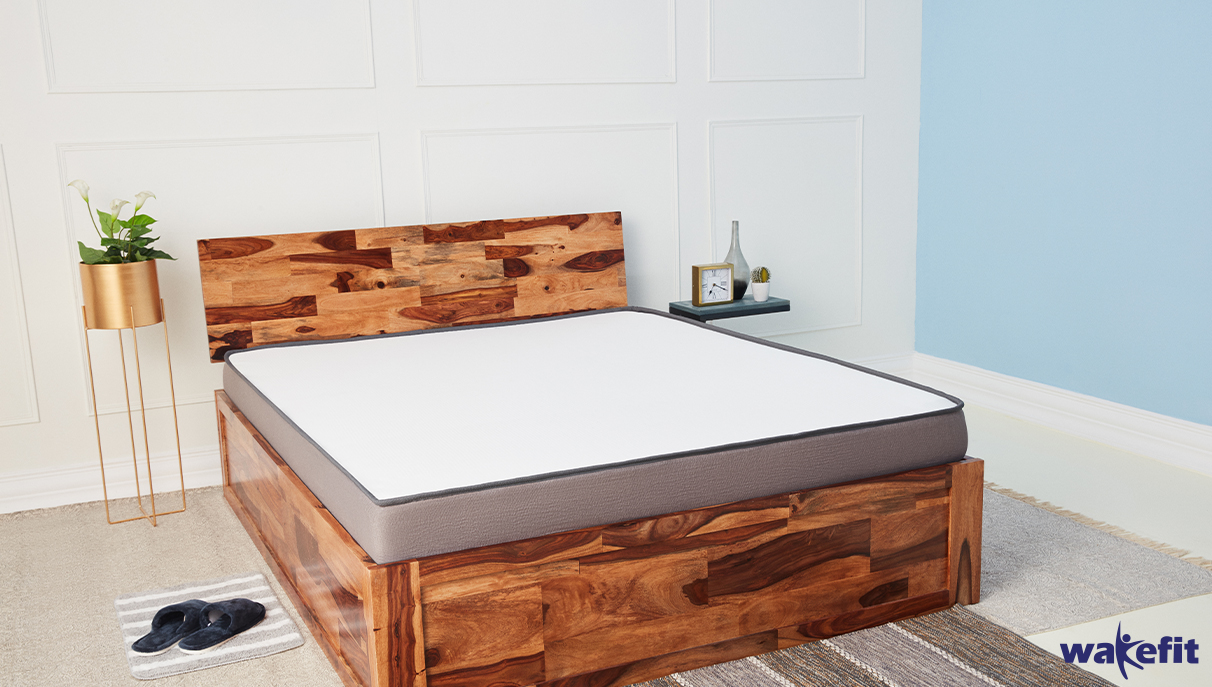
The rule: if the mattress is under 6 years old and structurally sound, a topper is almost always worth it. If it is 7-8 years old with any visible sagging, skip the topper and go straight to a replacement. When a new mattress is the right call, Wakefit’s Orthopaedic Memory Foam Mattress uses 72 kg/m3 OEKO-TEX certified foam – the density at which the mattress holds its shape for 8-10 years under normal use. It comes with a 100-night free trial, so you are not committing Rs 20,000+ without sleeping on it first. Browse the full mattress range here.
How do you choose the right mattress topper thickness?
Thickness is the most important spec and the most misunderstood one. Thicker is not always better.
- 2-4 cm: Minor adjustment. Softens a very slightly firm surface. Barely visible under sheets. Best for stomach sleepers (thicker toppers push the spine into hyperextension) or if you want a subtle change.
- 5-7 cm: The most versatile choice. Noticeable difference in feel. Suits side sleepers and back sleepers wanting a firm-to-medium conversion. This is the right range for most people.
- 8-10 cm: Major transformation. Only worth it when the mattress underneath is very firm but still structurally perfect – and when you specifically want a plush, cloud-like feel.
For ILD (firmness): 20-28 ILD = soft (pressure relief, side sleepers); 29-40 ILD = medium (back sleepers, balanced feel); 40+ ILD = firm (stomach sleepers, back pain requiring firm support). Most product listings in India do not publish ILD, but latex toppers from organised sellers typically do – ask before buying.
Frequently Asked Questions
1. Can a mattress topper fix a sagging mattress?
No. A topper adds a comfort layer on top but does not correct the underlying dip. If your mattress sags 3+ cm when you lie on it, the internal support has failed. A topper will conform to the same dip within a few weeks. The right fix is a new mattress, not a topper.
2. How long does a mattress topper last in India?
Latex toppers last 5-7 years; memory foam 3-5 years; high-density foam 2-3 years; fibre 1-2 years. In India’s humidity, memory foam toppers benefit from monthly airing and a mattress protector on top to extend their lifespan. A topper that permanently indents (does not rebound when pressed) has reached end of life.
3. Is a mattress topper good for back pain?
A latex topper in the medium-firm range (ILD 28-36) is the best option for back pain – it is responsive rather than cradling, which maintains lumbar alignment. Thick memory foam (8-10 cm) can let the lower back sink too deeply. For back pain specifically, choose latex at 5-7 cm thickness and medium-firm ILD.
4. Can I use a mattress topper on any type of mattress?
Yes – foam, spring, latex, coir, and hybrid mattresses all work with a topper. The topper sits on top and is held in place by elastic corner straps. It works with any flat mattress surface. The only exception is a water bed or heavily contoured adjustable mattress, which needs a topper specifically designed for that base.
5. What is the difference between a mattress topper and a mattress protector?
A mattress protector (0.1-0.5 cm thick) protects the mattress from water, stains, and allergens – it does not change how the mattress feels. A topper (2-10 cm thick) meaningfully changes the sleep surface. You can use both together: a protector under the topper to protect the mattress, and another protector on top of the topper to protect that too.
6. How do I clean a mattress topper?
Latex and memory foam toppers cannot go in a washing machine – the structure breaks apart. Spot-clean with mild detergent on a damp cloth, then air-dry fully before putting sheets back. Keep a washable mattress protector on top of the topper to reduce how often the topper itself needs cleaning. Fibre toppers can usually be machine-washed on a gentle cycle – check the care label.
7. Which mattress topper is best for hot sleepers in India?
Latex is the best choice for hot sleepers – it is naturally breathable and does not trap body heat the way memory foam does. Avoid thick memory foam toppers (8-10 cm) in non-AC rooms from April to September. Fibre toppers are also breathable but compress quickly and do not provide meaningful support over time.
8. At what point should I buy a new mattress instead of a topper?
Replace the mattress if: there is visible sagging of 3+ cm when you lie down; the mattress is over 8 years old with any comfort issues; there is a musty smell indicating moisture damage; or springs are creaking and support feels uneven. A topper will not fix any of these – it only addresses surface firmness on a structurally sound mattress.

No Comments