
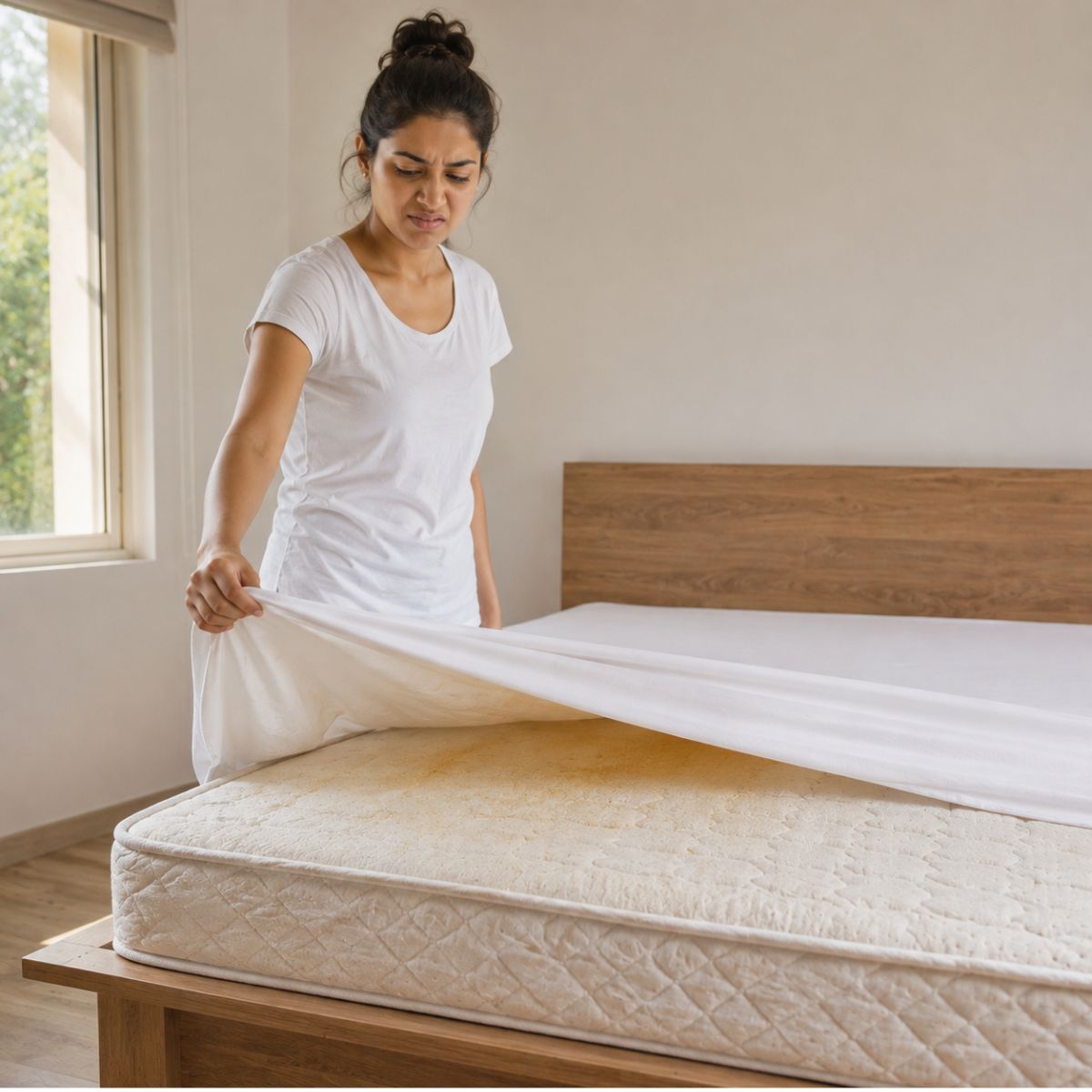

Most mattress smells respond to baking soda and sunlight within 24 hours. The method matters though – the same treatment does not work equally for sweat odour, mould, and pet accidents. Here is how to identify what you are dealing with and remove it properly.
What is causing your mattress to smell?
Before reaching for the baking soda, identify the source. Treating the wrong kind of smell wastes time and sometimes makes it worse.
Sweat and body oils produce a faint sour or stale smell, usually most noticeable near the head and middle of the mattress. You may notice slight yellowing on the surface. This is the most common cause and the most straightforward to treat.
Mould or mildew has a distinctly musty, earthy smell – different from sweat. In India, this is most common after monsoon months when humidity stays above 70%. Visible signs include grey, black, or greenish patches, usually on the underside or edges first.
Pet accidents leave a sharp ammonia smell that intensifies when the mattress gets warm. Even a small spill can soak into foam layers and be difficult to reach from the surface alone.
Old foam off-gassing – a faint chemical smell – is normal in new mattresses and fades within days. If your mattress is several years old and has a chemical smell, it may be foam degradation rather than a surface odour. This does not respond to cleaning.
How to remove sweat and body odour from a mattress
This is the standard treatment for everyday mattress smell.
Baking soda method (most effective for sweat):
- Strip all bedding and lay the mattress flat.
- Sprinkle a generous, even layer of baking soda across the entire surface.
- Leave it for a minimum of 4 hours – overnight is better for established smells.
- Vacuum thoroughly with an upholstery attachment.
- Flip and repeat on the other side if needed.
Baking soda is mildly alkaline and neutralises the acidic compounds in sweat. It absorbs odour rather than masking it. Even when there is no noticeable smell, doing this every 3-4 months prevents build-up.
White vinegar spray (for more stubborn sweat odour): Mix one part white vinegar with one part water in a spray bottle. Lightly mist the surface – do not soak the mattress. Air-dry completely with windows open before replacing bedding. The vinegar smell dissipates as it dries and takes the odour with it.
How to treat mould on a mattress in India
Mould is a more serious problem than surface odour and needs a different approach. In coastal cities and during monsoon, foam mattresses can develop mould quickly if there is no airflow underneath or if there has been any moisture exposure.
Identifying mould vs staining: Press a tissue against the discoloured patch. Mould typically has a powdery or slightly fuzzy texture; a stain does not. Mould also has a persistent musty smell even when the surface looks dry.
Treatment steps:
- Move the mattress to a well-ventilated space – outside in sunlight if possible.
- Mix one part white vinegar with one part water. Apply lightly to the affected area using a cloth. Do not spray directly into foam.
- Let it sit for 10-15 minutes, then blot – do not scrub, which spreads spores.
- Leave in direct sunlight for 4-6 hours. UV light kills mould spores on the surface.
- Once completely dry, apply baking soda to the area, leave for 2 hours, then vacuum.
When mould cannot be saved: If patches are larger than 30cm, or the musty smell persists after treatment, the mould has penetrated deeper than surface methods can reach. At that point the mattress is not safe to sleep on – deep foam mould affects air quality and can cause respiratory irritation, particularly in children. Replacement is the right call.
How to remove pet odour from a mattress
Pet accidents need to be treated while still wet if possible. For dried odour:
- Sprinkle baking soda generously on the affected area.
- Add a few drops of white vinegar directly onto the baking soda – it will fizz, which is normal.
- Let it sit for 5-10 minutes, then blot and vacuum once dry.
- Repeat if the smell persists – two or three treatments are often needed for pet urine.
For persistent pet odour that baking soda does not fully clear, an enzymatic cleaner breaks down the proteins in urine rather than masking them. These are available at pet stores and work more thoroughly for ammonia-based smells than vinegar alone.
Odour type, treatment, and how long it takes
| Odour Type | Cause | Best Treatment | Time Needed |
|---|---|---|---|
| Sweat / body odour | Accumulated oils and perspiration | Baking soda + vacuum | 4-8 hours |
| Mould / mildew | Humidity, trapped moisture | White vinegar + direct sunlight | 1 full day |
| Pet urine | Ammonia proteins in foam | Baking soda + vinegar, or enzymatic cleaner | 1-2 days, multiple rounds |
| General staleness | Dust, dead skin cells over time | Baking soda + vacuum | 4 hours |
| Old foam / chemical | Foam degradation in older mattresses | Ventilation only; may not resolve | Weeks – may be permanent |
How often should you deep clean a mattress in India?
In Indian conditions, a basic deodorising treatment – baking soda and vacuum – every 3 months is right for most households. The monsoon season changes this schedule.
Before monsoon (May-June): Apply baking soda, vacuum thoroughly, and check the underside for early mould signs. In humid cities, stand the mattress upright for a few hours to air out the base.
After monsoon (October): Repeat the full treatment. Air the mattress in direct sunlight for at least one full day if you can. This is the most important clean of the year for Indian homes.
Immediately after any spillage: Do not wait. Liquid in foam layers takes up to 48 hours to fully evaporate, and mould can begin forming within that window.
Five habits that keep a mattress fresh long-term
1. Use a waterproof mattress protector. This is the single most effective thing you can do. A good mattress protector keeps sweat, spills, and humidity from reaching the foam. Wash it every 2-4 weeks – most people wash it far less often than that.
2. Ventilate every morning. Before making the bed, leave the mattress uncovered for 15-20 minutes. Body moisture accumulated overnight evaporates instead of being trapped under bedding.
3. Rotate every 3-6 months. Rotating 180 degrees distributes wear and prevents sweat from accumulating in the same spot consistently.
4. Get sunlight on it twice a year. Even one day of direct sunlight does more than most cleaning products. UV light kills bacteria and surface mould spores, and heat drives moisture out from deep in the foam.
5. Keep airflow under the mattress. Avoid placing a mattress on the floor – especially during monsoon. A slatted bed base with gaps allows air circulation on the underside and significantly reduces mould risk in humid conditions.
When the smell will not go away
If the smell returns within a few days of treatment, the odour source is deeper in the foam than surface methods can reach. This typically applies to mould that has grown through multiple foam layers, pet urine that soaked to the base, and foam that has broken down chemically over many years of use.
At this point, a new mattress is the practical answer. Adding a waterproof mattress protector on the new one from day one will prevent the same problem from developing again.
Frequently asked questions about mattress odour removal
How do I remove bad smells from my mattress?
The most effective method for everyday smells: sprinkle baking soda generously across the surface, leave for 4-8 hours, then vacuum. For mould, use diluted white vinegar followed by sunlight. The right treatment depends on the source – sweat, mould, and pet odours each respond differently.
Will mattress smell go away on its own?
Light sweat odour can fade with ventilation but does not fully clear without treatment. Mould smell will not go away on its own and gets worse over time. Pet urine odour stays in the foam indefinitely if untreated.
How long does baking soda take to deodorize a mattress?
A minimum of 4 hours for light odours. For stronger or established smells, leave it overnight – 8 to 12 hours. The longer it sits, the more it absorbs.
Is it safe to sleep on a mattress with mould?
Not if the mould is visible or extensive. Surface mould releases spores into the air as you move on the mattress, which can cause respiratory irritation, particularly for children and people with asthma. Treat immediately or replace.
Can mould be removed from a mattress?
Surface mould caught early can be treated with white vinegar and direct sunlight. Deep foam mould – where the smell persists after surface treatment, or patches are larger than 30cm – cannot be fully removed and the mattress should be replaced.
Why does my mattress keep getting mouldy?
The most common reasons in India: no airflow under the mattress, no waterproof protector allowing sweat to penetrate the foam, and high ambient humidity during monsoon. Fixing the base setup and using a waterproof protector solves this in most cases.
How often should I use baking soda on my mattress?
Every 3 months as a maintenance step, and immediately after any spill or when odour develops. Pre-monsoon (May-June) and post-monsoon (October) are the two most important moments in Indian conditions.
Does white vinegar damage a mattress?
Used correctly – diluted 1:1 with water, applied lightly with a cloth, not soaked into the foam – white vinegar does not damage most mattresses. Do not pour vinegar directly onto foam. Let it dry completely before replacing bedding.



No Comments