
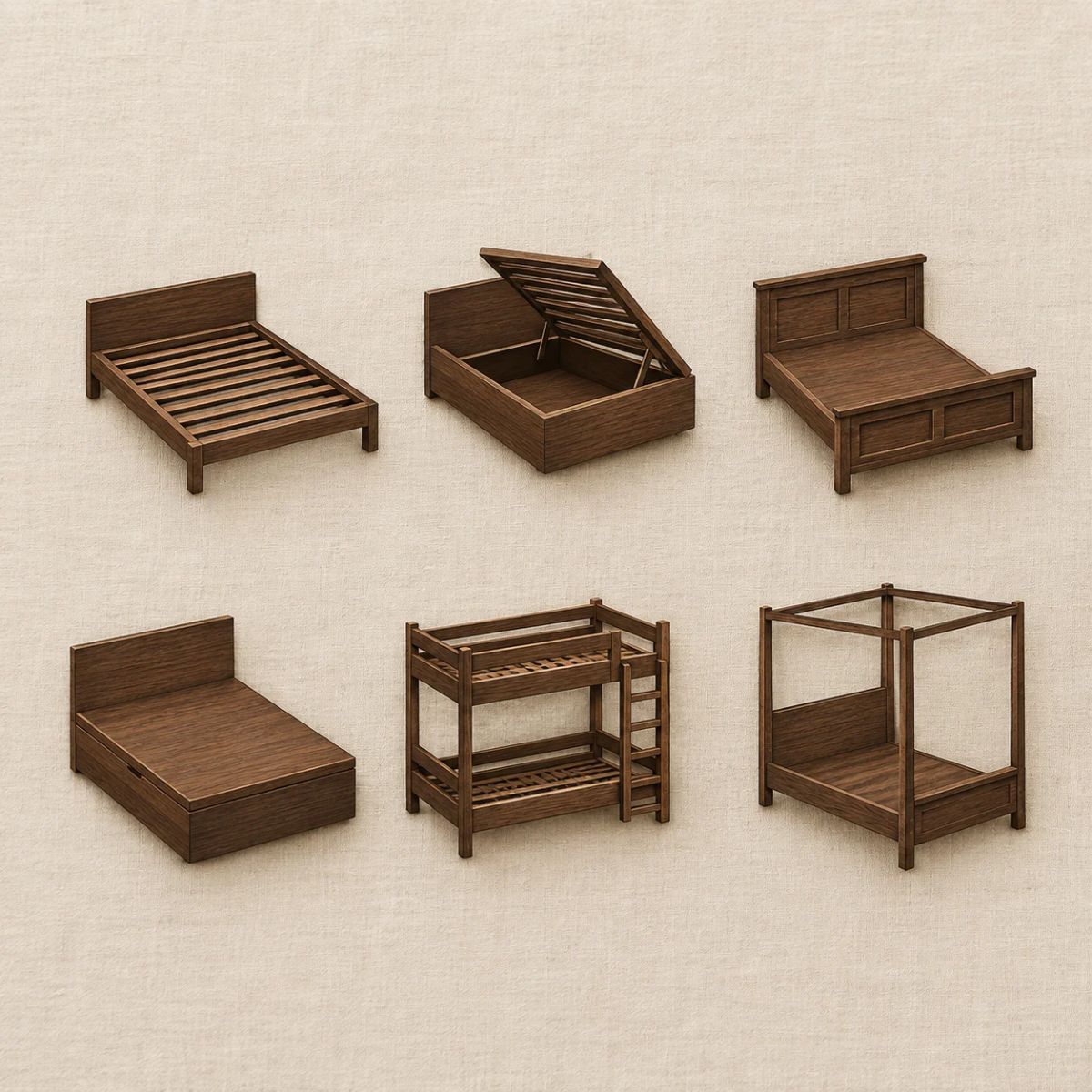

Search for “types of beds” and you will get answers ranging from 4 to 14 depending on who you ask – because there is more than one way to categorise a bed. By frame design, you get platform, panel, sleigh, four-poster, and canopy. By storage mechanism, you get hydraulic lift, drawer storage, and no storage. By function, you get sofa cum bed, bunk bed, trundle bed, and Murphy bed. This guide covers all of them, explains which matter most for Indian homes, and gives you a comparison table to find the right type for your room, budget, and storage needs.
Key takeaways
- There are broadly 9 types of beds – platform, panel/sleigh, divan, four-poster, storage/hydraulic, bunk, trundle, sofa cum bed, and Murphy bed
- For Indian apartments, the hydraulic storage bed is the most practical choice – it lifts the mattress on a gas piston to reveal full under-bed storage
- Platform beds are the most popular modern choice in India; they need no box spring and suit most Indian floor-height preferences
- Divan beds (upholstered base) are gaining popularity in urban India but offer no storage – choose them for aesthetics, not utility
- Bunk beds are not just for children – loft-style single bunk frames are increasingly used in studio apartments and co-living spaces
What are all the types of beds available in India?
| Bed Type | Key feature | Storage? | Best for | Price range |
|---|---|---|---|---|
| Platform bed | Flat slatted or solid base; no box spring needed | No (unless combined with storage) | Most Indian bedrooms; modern aesthetic; low profile | ₹15,000-80,000 |
| Storage bed (hydraulic) | Gas-piston mechanism lifts mattress to reveal full under-bed storage | Yes – large | Small apartments; maximising storage in limited space | ₹20,000-1,00,000 |
| Storage bed (drawer) | Side-pull drawers built into the bed base | Yes – moderate | Rooms where full hydraulic lift is not needed; accessible daily storage | ₹18,000-70,000 |
| Panel bed | Traditional headboard + footboard framing the mattress | No | Classic / traditional interiors; solid wood homes | ₹20,000-1,50,000 |
| Sleigh bed | Curved inward-scrolling headboard and footboard | No | Traditional or transitional interiors; statement piece | ₹25,000-1,20,000 |
| Divan bed | Fully upholstered fabric or leatherette base with no legs visible | Optional | Modern minimalist rooms; premium aesthetic | ₹25,000-1,50,000 |
| Four-poster / canopy bed | Four vertical posts at corners; canopy variant adds overhead fabric | No | Large master bedrooms; traditional or luxury interiors | ₹40,000-3,00,000+ |
| Bunk bed | Two stacked sleeping surfaces on a single frame | Some variants | Children sharing a room; co-living; studio apartments | ₹12,000-60,000 |
| Trundle bed | Secondary pull-out bed stored on wheels under the main bed | No (secondary bed IS the storage) | Guest rooms; children’s rooms where a second bed is occasionally needed | ₹18,000-50,000 |
| Sofa cum bed / daybed | Converts between seating and sleeping position | Some variants | Studio apartments; living rooms that double as guest rooms | ₹15,000-60,000 |
| Murphy / wall bed | Folds up vertically into a wall cabinet when not in use | Cabinet surround | Multipurpose rooms; very small apartments | ₹40,000-2,00,000+ |
What are the 4 most common types of beds in Indian homes?
If you narrow it to the four types that account for the vast majority of beds sold in India today, they are: the platform bed, the hydraulic storage bed, the panel bed, and the divan bed. Here is what distinguishes each.
1. Platform bed – A flat base (solid wood, slatted, or engineered wood) at a fixed height, no box spring required. The most widely available type in India across all price points. Works with any mattress type. Modern, clean lines.
2. Hydraulic storage bed – A platform bed with a gas-piston mechanism under the base. Lift the mattress and the entire base opens upward, revealing a large storage cavity. The most practical bed type for Indian apartments where storage is limited. Can hold luggage, seasonal bedding, extra pillows, and linen.
3. Panel bed – A traditional framed bed with a headboard and footboard. The most classic design, often in solid wood (sheesham, teak, mango). Suits traditional or transitional interiors. Heavier and less modular than platform beds.
4. Divan bed – A fully upholstered base with no visible legs or frame, covered in fabric or leatherette. The bed floats as a single upholstered block. Premium aesthetic, no under-bed storage or visibility. Growing in popularity in urban Indian homes as a style statement.
Platform bed vs hydraulic storage bed: which is better for Indian apartments?
For most Indian apartment buyers, the hydraulic storage bed wins – not because it is a better bed, but because Indian apartments are storage-deficient by design. A 2BHK in Bengaluru or Mumbai typically has one small wardrobe per bedroom and no dedicated linen cupboard. The under-bed cavity in a queen hydraulic storage bed holds approximately 8-10 cubic feet of storage – equivalent to a full wardrobe shelf. That space is otherwise wasted in a platform bed.
| Platform bed | Hydraulic storage bed | |
|---|---|---|
| Under-bed storage | No (open space under the frame) | Yes – full cavity, typically 10-12 inches deep |
| Mechanism maintenance | None | Gas pistons need checking every 3-5 years |
| Moving the bed | Easy – lift and carry each piece | Harder – mechanism adds significant weight |
| Mattress access | Fixed | Lift mattress and base to access storage |
| Price premium | Base price | Typically ₹5,000-15,000 more than equivalent platform |
| Best for | Homes with adequate wardrobe/external storage | Apartments where under-bed space is the only available storage |
Which type of bed is best for a small bedroom?
For a bedroom under 120 sq ft, choose a hydraulic storage bed in single or queen size. It gives you full sleeping surface with maximum storage built in, without requiring an additional chest of drawers or almirah that would eat into floor space. The second-best option for very small rooms is a loft bunk bed (single sleeping surface elevated on long legs with a desk or storage unit underneath) – it trades floor space for vertical space.
Avoid four-poster, sleigh, and canopy beds in small rooms – their visual bulk and physical footprint (the posts extend the bed’s effective dimension) make a small room feel cramped. Divan beds without visible legs also tend to make small rooms feel heavier and lower.
Bed types by material: which frame material lasts longest in India?
| Material | Common bed types it is used for | Lifespan | Termite risk | Humidity resistance | Best for |
|---|---|---|---|---|---|
| Solid wood (sheesham, teak) | Panel, platform, four-poster | 20-30+ years | High – needs treatment | Moderate – can warp if untreated | Long-term investment; traditional homes |
| Engineered wood (MDF/HDF) | Platform, storage, divan base | 8-12 years | Low | Low – swells if exposed to water | Modern apartments; design variety |
| Metal (steel/iron) | Platform, bunk, four-poster | 15-25 years | None | High – powder coating prevents rust | Durability priority; bunk beds |
| Upholstered (fabric/leatherette) | Divan, panel headboard | 7-10 years (fabric), 5-8 years (leatherette) | None (frame is wood/metal) | Low – fabric absorbs humidity | Aesthetics; premium rooms; dry climates |
The Wakefit bed range includes platform and hydraulic storage beds in engineered wood with moisture-resistant laminates – the most practical material choice for Indian apartment conditions. Each bed comes with a compatible mattress option and a 100-night trial so you can assess whether the bed height and firmness work for your room before committing.
Frequently Asked Questions
1. What are the types of beds?
The main types of beds are: platform bed, panel bed, sleigh bed, divan bed, four-poster bed, canopy bed, hydraulic storage bed, drawer storage bed, bunk bed, trundle bed, sofa cum bed, and Murphy wall bed. In India, the platform bed and hydraulic storage bed are the most commonly purchased types for residential use.
2. What are the 4 types of beds?
If you narrow it to four, the most relevant types for Indian buyers are: platform bed (flat base, no box spring, most versatile), hydraulic storage bed (gas-piston lift mechanism with storage underneath), panel bed (traditional framed headboard and footboard design), and divan bed (fully upholstered base with no visible legs or frame). These four cover the majority of beds sold in India today.
3. What are the 9 types of beds?
Nine distinct bed types are: platform bed, hydraulic storage bed, panel or sleigh bed, divan bed, four-poster or canopy bed, bunk bed, trundle bed, sofa cum bed or daybed, and Murphy or wall bed. Each has a distinct frame design, storage function, or sleeping mechanism that separates it from the others.
4. What is a hydraulic storage bed and how does it work?
A hydraulic storage bed has gas-piston cylinders built into the base. When you lift the mattress from the foot end, the pistons bear the weight and hold the base in the open position – similar to how a car boot stays open. The entire base opens upward, revealing a large cavity underneath. To close, you push the base down and the pistons compress slowly. The mechanism requires no electricity and lasts 3-5 years before the pistons may need servicing.
5. What is the difference between a platform bed and a divan bed?
A platform bed has a visible frame with legs, a slatted or solid base, and open space underneath. A divan bed is a fully upholstered base – fabric or leatherette covers the entire base from floor to mattress level, with no visible legs or frame. Platform beds are more versatile and easier to move; divan beds have a cleaner, more premium look but are heavier and offer no under-bed visibility or ventilation.
6. Which type of bed is best for back pain?
The bed type (frame design) has minimal direct impact on back pain – the mattress does. However, the bed frame affects mattress support indirectly: a platform bed with solid or closely-spaced slats provides the firmest, most even support for the mattress. Avoid frames with widely-spaced or sagging slats, which cause the mattress to sag into the gaps and reduce its firmness. For back pain, prioritise the mattress first, then ensure the frame provides even, gap-free support underneath.
7. Are bunk beds safe for adults?
Bunk beds rated for adult use are safe when the frame is made of solid steel or thick solid wood and is rated for 120-150 kg per bunk. Standard children’s bunk beds (rated for 80-100 kg) are not appropriate for adult use – the upper bunk in particular experiences significant lateral stress when an adult moves during sleep. Check the manufacturer’s weight rating before using any bunk bed for adult sleepers.
8. What type of bed is best for a small room in India?
A hydraulic storage bed is best for a small bedroom because it maximises storage without requiring additional furniture. It gives you the full sleeping surface of a standard platform bed plus 8-10 cubic feet of under-bed storage. For very small rooms (under 100 sq ft), a loft bunk bed (single elevated sleeping surface with open space or storage underneath) reclaims floor space by going vertical. Avoid four-poster, canopy, and sleigh beds in small rooms – their frame bulk makes the room feel smaller.


No Comments