
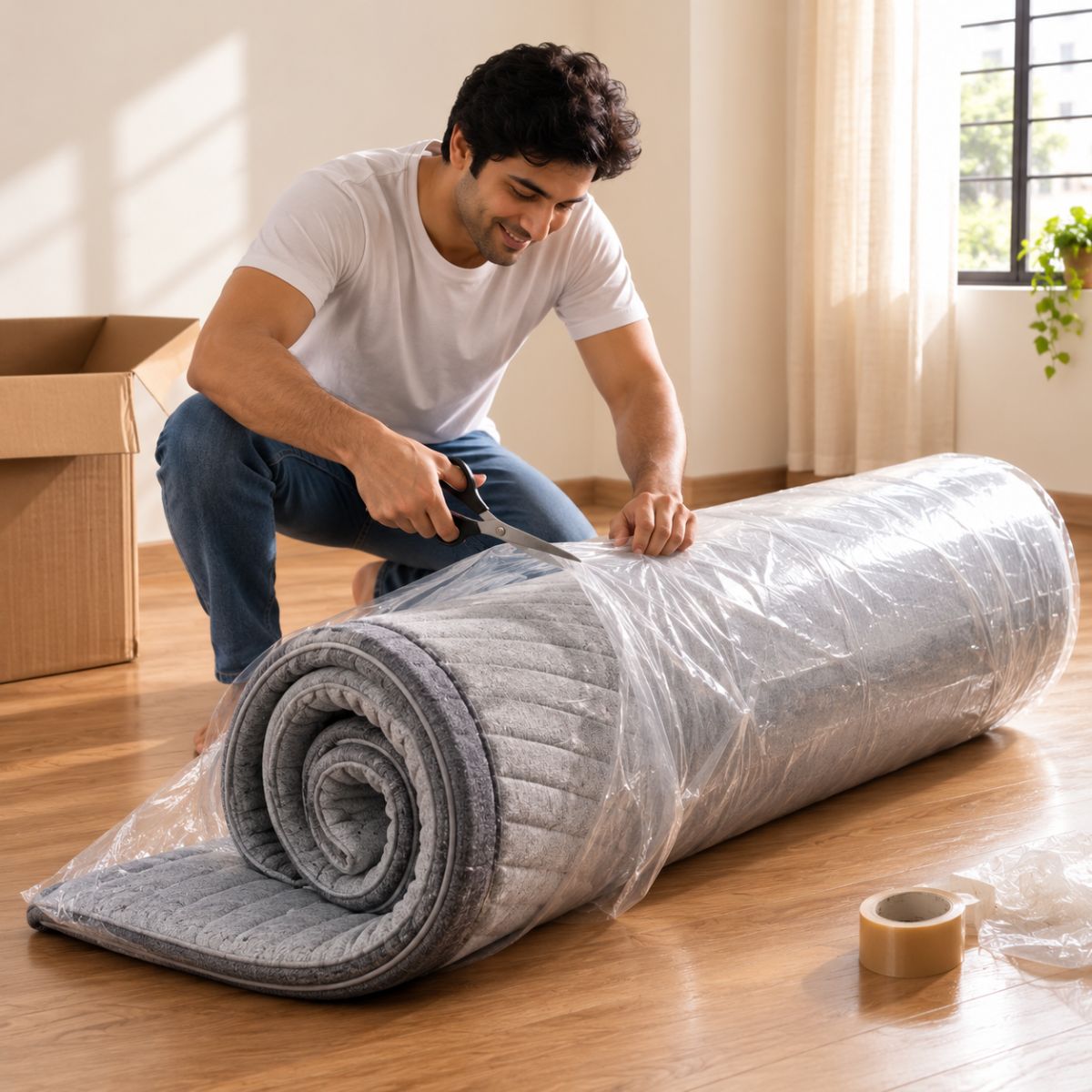

Your mattress in a box has arrived, you have cut the packaging, and it is slowly expanding on your bedroom floor – or not expanding as fast as you expected. Over the next 30 days, you will likely have a series of questions that no one warned you about: why does it smell? why does it feel firmer than the product page suggested? is this dip in the corner normal? when can I actually sleep on it? This guide answers all of them in one place, tells you what is completely normal during break-in, and tells you the specific signs that mean something is actually wrong and worth raising with the support team.
Key takeaways
- Most mattresses reach 90% expansion within 4-6 hours and full expansion within 24-72 hours – cold rooms slow this down significantly
- A slight chemical or foam smell in the first 3-7 days is normal off-gassing and is not a safety concern
- The break-in period is 30-60 days – the mattress will feel firmer than its final state for the first few weeks
- You can sleep on a rolled mattress from the first night – you do not need to wait 24 hours, though the smell may still be present
- If the mattress has not reached its advertised thickness after 72 hours in a warm room, or if a visible sag appears within the first 30 days, contact support – these are not normal
How does a mattress get compressed into a box – and does that affect its quality?
Roll-packing – the process used in mattress in a box products – compresses the mattress to roughly 20-25% of its original thickness using industrial rollers and vacuum sealing. The mattress is then rolled and packed into a cylindrical box. This is a manufacturing and logistics innovation, not a compromise on quality. The same foam and materials that go into a traditionally delivered mattress go into a rolled one – the difference is in the delivery format.
The compression does not damage foam or spring structures when done correctly. Memory foam is particularly well suited to roll-packing because its viscoelastic properties allow it to compress and recover without permanent deformation. Pocket spring mattresses can also be roll-packed – the spring coils compress and re-extend. Bonnell spring and coir mattresses are typically not roll-packed because their rigid structures do not compress and recover cleanly.
How long does a mattress in a box take to fully expand?
Expansion time varies by foam type and room temperature. The table below gives the typical ranges.
| Mattress Type | 90% Expansion | Full Expansion | What Affects It |
|---|---|---|---|
| Memory foam | 4-8 hours | 24-72 hours | Room temperature is the biggest factor – below 18°C slows expansion significantly; above 25°C speeds it up |
| High-density PU foam | 2-4 hours | 12-48 hours | Expands faster than memory foam; may reach full thickness within 12 hours in a warm room |
| Pocket spring with foam layers | 4-6 hours | 24-48 hours | Springs extend quickly; foam comfort layers take longer; the mattress may feel fully expanded before it is |
| Latex | 6-12 hours | 48-72 hours (sometimes up to 7 days for full body adaptation) | Latex is denser and takes the longest to fully recover; the mattress is safe to sleep on before this, but may feel firmer than its final state |
Room temperature is the single factor most people overlook. Foam is a temperature-sensitive material – cold foam is stiffer and expands more slowly. If your mattress arrives in January in a room that has been closed for days, or in a cold storage area, bring it to room temperature before cutting the packaging. A 15°C room can more than double the expansion time compared to a 25°C room. This is particularly relevant in India during winter months in north Indian cities where room temperatures can drop to 10-15°C at night.
Can you sleep on a mattress in a box on the first night?
Yes. Most mattress brands – including Wakefit – confirm that sleeping on the mattress from the first night is safe and does not affect the mattress’s performance or your warranty. The common recommendation to “wait 24-48 hours” is a guideline for reaching full expansion, not a safety requirement. The mattress at 80-90% expansion is still a functional sleep surface.
Two things to be aware of on night one: the off-gassing smell (see below) may still be present, and the mattress may feel slightly firmer than its advertised firmness because the foam is still in its compressed state. Neither of these is a reason to delay sleeping on it if you need to.
Why does a new mattress smell – and when does it become a concern?
The smell from a new mattress – often described as slightly chemical, plasticky, or like new foam – is called off-gassing. It is produced by volatile organic compounds (VOCs) released from the foam, adhesives, and fabric treatments used in manufacturing. The compression intensifies the smell because the compounds are sealed in the packaging and released all at once when the mattress is opened.
Off-gassing from a correctly manufactured mattress is not a health hazard. For mattresses carrying OEKO-TEX Standard 100 or CertiPUR-US certification, the VOC levels are independently verified to be within safe limits. The smell typically dissipates within 3-7 days with normal room ventilation – opening a window or running a fan in the room speeds this up. In a closed room with no airflow, it may take up to two weeks.
The smell becomes a concern in two situations: if it persists beyond two weeks with adequate ventilation, or if it is accompanied by eye or throat irritation that is clearly linked to the mattress. The first is unusual with a certified mattress; the second almost never happens with products that carry legitimate OEKO-TEX or CertiPUR-US certification. If either occurs, contact the support team with your order details.
What is the break-in period and why does the mattress feel different from what you expected?
The break-in period is the 30-60 day window during which the foam adjusts from its compressed, factory-fresh state to its permanent sleeping surface. During this period, the mattress will typically feel firmer than it will at the end of the break-in. This is normal and expected – it is not a defect.
There are two things happening simultaneously during break-in. First, the foam cells gradually relax from the compressive stress of roll-packing and settle into their full, uncompressed structure. Second, your body is adapting to a new sleep surface – adjusting posture patterns, pressure point distribution, and muscle tension that had formed around your previous mattress over months or years. Both processes take time, and the combined effect is that week one is almost always the hardest week on any new mattress, regardless of quality.
| Week / Phase | What You May Notice | Is It Normal? |
|---|---|---|
| Day 1-3 (unboxing) | Foam smell, firmer than expected, mattress slightly uneven in corners | Yes – all normal. Smell dissipates; firmness and unevenness resolve as foam expands |
| Week 1-2 | Feels firmer than advertised; some morning stiffness if switching from a softer mattress; mattress may creak if pocket spring | Yes – normal break-in. Body and foam both adjusting |
| Week 3-4 | Firmness softening slightly toward advertised feel; stiffness reducing; smell gone | Yes – foam reaching its permanent state |
| After 30 days | Mattress should feel close to its described firmness; any discomfort should be position or preference-related rather than surface-related | If discomfort persists after 30 days, it is worth evaluating whether the firmness is genuinely wrong for your sleep position |
What is normal in the first month – and what is not?
Normal – no action needed:
- Foam smell that fades over 3-7 days with ventilation
- Feeling firmer than expected for the first 2-4 weeks
- Slight unevenness or corner depression that resolves within 72 hours of full expansion
- Morning stiffness when switching from a significantly softer previous mattress – this is body adaptation, not a mattress defect
- Minor surface indentations where you sleep that disappear when you get up – this is normal foam compression, not permanent sagging
- A slight sound from pocket spring mattresses when first used – new springs settling
Not normal – contact support:
- Mattress thickness significantly below the advertised measurement after 72 hours in a warm room (measure at the centre, not the edge)
- A visible, permanent body impression or sag within the first 30 days that does not spring back when you get up
- Strong chemical smell that persists beyond two weeks with daily ventilation
- Visible tears, holes, or seam separation in the fabric cover
- Hard lumps or soft spots that do not resolve after the break-in period
- Spring noise that is present from the first night and does not reduce after the first week
Tips to help your mattress expand faster and settle better
- Cut the packaging in the room where you will use it. Moving a half-expanded mattress is harder than moving a compressed one, and expansion in the correct room means the mattress adapts to that environment’s temperature and humidity from day one
- Remove all plastic immediately. The plastic wrap slows expansion by keeping the compressed shape. Cut it away completely as soon as the mattress is in position
- Keep the room warm. Above 22°C is ideal. If you are unpacking in winter, run a room heater for an hour before cutting the packaging
- Ventilate the room. Open a window for the first three days to speed off-gassing and bring fresh air to the expanding foam
- Rotate the mattress weekly for the first month. Most mattresses are designed to be rotated 180 degrees (head to foot) but not flipped. Rotating helps the foam settle evenly rather than conforming to one sleep zone during break-in
- Do not store the mattress compressed. Once the packaging is cut, the expansion process begins and cannot be cleanly reversed. If the mattress needs to move rooms, carry it flat rather than rolling it again
When should you use the 100-night trial – and when is it too early to decide?
The 100-night trial that comes with Wakefit mattresses and similar brands is designed for exactly this situation: the first month is break-in time, and a verdict on a new mattress formed in week one is almost never accurate. The foam has not settled, your body has not adapted, and the firmness you are sleeping on is not the firmness you will have at day 60.
The right approach: give the mattress 30 nights before forming a view on whether the firmness is genuinely wrong for you. If by day 30 the discomfort is position-related (shoulder pain as a side sleeper, hip pain as a back sleeper) and shows no sign of improving, that is useful information about a firmness mismatch. If by day 30 the discomfort is reducing week over week, the break-in is working and the mattress is likely correct for you.
Contact the Wakefit support team or initiate a trial return if, after 30 nights, the mattress has a structural issue (visible sag, lumps, seam damage) or if the firmness is genuinely incompatible with your sleep position after break-in. The Wakefit Orthopaedic Memory Foam Mattress support team can also advise on whether what you are experiencing is break-in or a defect – the distinction is usually straightforward from the description.
Frequently Asked Questions
1. How long does a Wakefit mattress take to expand?
A Wakefit memory foam mattress typically reaches 90% expansion within 4-8 hours and full expansion within 24-72 hours. Room temperature is the biggest factor – a warm room (22-28°C, typical in most Indian bedrooms outside winter) speeds expansion, while a cold room can more than double the time. You can sleep on the mattress from the first night even if it has not reached full expansion – this is safe and does not affect the mattress’s performance.
2. My mattress has a strong smell after unboxing. Is it safe to sleep on?
Yes. The smell is off-gassing from the foam and adhesive materials, which intensifies when released from compression. For mattresses with OEKO-TEX Standard 100 certification (like Wakefit), the VOC levels are independently verified to be within safe limits. Open a window or run a fan in the room to accelerate dissipation – the smell typically resolves within 3-7 days. If it persists beyond two weeks with daily ventilation, contact support.
3. My new mattress feels harder than expected. Is something wrong?
Almost certainly not. New foam – particularly memory foam – is stiffer in its compressed, factory-fresh state and during the first weeks of use. The break-in period of 30-60 days is when the foam cells relax and the mattress reaches its permanent feel, which is typically slightly softer than the first week. Give it 30 nights before judging the firmness. If it still feels significantly harder than the described level after 30 nights, that is worth raising with support.
4. Can I sleep on a mattress in a box immediately after unboxing?
Yes. You do not need to wait 24-48 hours – that is a guideline for full expansion, not a safety requirement. The mattress at 80-90% expansion (typically reached within 4-6 hours) is a fully functional sleep surface. The smell may still be present on night one; ventilate the room and it will reduce significantly by night two or three.
5. My mattress is not fully expanded after 48 hours. What should I do?
Check the room temperature first. If the room is below 18°C, the foam will expand much more slowly – bring the room to at least 22°C and give it another 24 hours. Make sure all the plastic wrap is removed. If after 72 hours in a warm room the mattress is visibly below its advertised thickness (measure at the centre with a tape measure), contact support with your order details and a photo – this is outside normal expansion behaviour and may indicate a manufacturing issue.
6. How do I know if my mattress has a defect or is just breaking in?
Break-in produces: temporary firmness that softens over 30-60 days, off-gassing smell that resolves with ventilation, and morning stiffness that reduces week over week. Defects produce: permanent visible sagging that does not spring back when you stand up, fabric tears or seam separation, lumps or hard spots that do not change after the break-in period, or persistent spring noise from the first night that does not reduce. If you are unsure, describe what you are experiencing to the support team – the distinction is usually clear from the description.
7. Should I rotate my new mattress?
Yes, and particularly during the first month. Rotate the mattress 180 degrees (head to foot, not flipped) every week for the first four weeks. This allows the foam to settle evenly across the entire surface rather than conforming primarily to your main sleep zone during break-in. After the first month, rotating every three months is adequate maintenance. Most foam mattresses are not designed to be flipped – check the label or product page to confirm before doing so.
8. Does rolling and compressing a mattress damage it?
No – when done by the manufacturer using industrial roll-packing equipment, the process does not damage foam or pocket spring structures. The foam and springs are designed to compress and recover within normal parameters. What can damage a mattress is re-rolling it yourself after it has expanded – DIY compression does not use controlled pressure and can create permanent deformation. Once your mattress has expanded, transport it flat rather than attempting to recompress it.


No Comments