
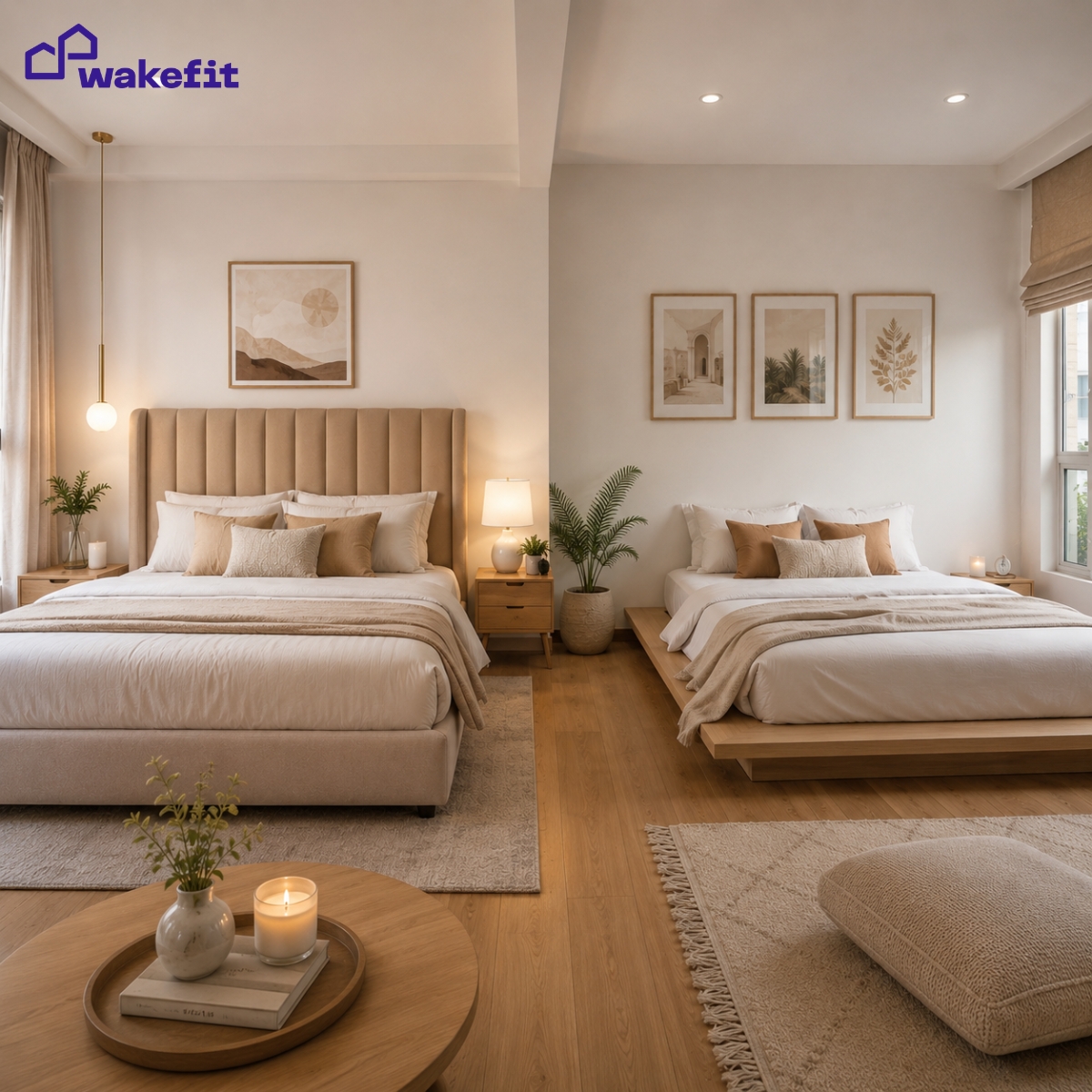

A bed with a headboard gives you wall protection, back support for reading or watching TV, and a clear visual anchor for the room. A bed without one works better in compact spaces, rentals, or minimal interiors where you want flexibility without committing to a fixed focal point. Neither is universally better – it depends on how you use the bedroom and what problem you’re actually trying to solve.
In Indian apartments, most people inherit a headboard-free setup and upgrade when they buy their own place. But the decision has more practical layers than most buying guides admit. A 10×12 bedroom responds very differently to a tall upholstered headboard than a low platform frame. This comparison breaks down every factor – cost, function, room size, and long-term practicality.
What does a headboard actually do beyond looking good?
Quite a lot – and most of it functional.
The most underrated benefit is wall protection. Every time you sit up in bed, lean back, or shift your pillow, body oil and hair grease transfers to the wall behind you. Over months this leaves visible marks that are difficult to clean off painted surfaces. A headboard eliminates this entirely by acting as a physical barrier. In apartments with light walls you cannot repaint, this alone can justify the purchase.
Back support is the second practical gain. If you spend time reading, scrolling your phone, or watching content propped up in bed, a headboard gives your back and neck something to rest against – which matters more than most people realise, since research on sedentary posture links prolonged unsupported sitting to increased lumbar strain. Without one, you’re either slouching against a pillow propped on the wall – which slides down constantly – or there’s nothing to lean on at all.
There’s also the room composition angle. A headboard creates a clear visual centre for the bedroom. It signals where the sleeping zone is and anchors everything else – side tables, wall art, lighting – around it. Rooms with headboard-free frames require more deliberate styling elsewhere to avoid looking unfinished.
What are the real advantages of going headboard-free?
The most straightforward one is cost. Bed frames without headboards are typically Rs. 3,000 to Rs. 10,000 cheaper than equivalent frames with them. For someone prioritising mattress quality over the frame aesthetic, that difference is worth redirecting.
The second is flexibility. If you rent, move frequently, or like changing your room’s look every couple of years, a headboard-free frame is much easier to live with. You’re not locked into a style, height, or colour that needs to work with every wall you’ll ever put it against.
Room dynamics is the third factor. In compact bedrooms – anything under 120 sq ft – a prominent headboard can make the room feel smaller and more enclosed. A low-profile platform bed without a headboard keeps sightlines open and the room feeling less cluttered, especially where ceiling heights are under 9 feet.
Headboard vs no headboard – which works better for you?
| Factor | Bed With Headboard | Bed Without Headboard |
|---|---|---|
| Wall protection | Yes – acts as a full barrier | No – wall marks develop over time |
| Back support (reading, TV) | Yes | No |
| Visual impact | Strong focal point | Minimal – suits minimal interiors |
| Room size suitability | Better in rooms 120 sq ft+ | Better in compact rooms under 120 sq ft |
| Decor flexibility | Style commitment – harder to change | Easily updated with new art or colours |
| Cost premium | Rs. 3,000-10,000 higher | Lower upfront cost |
| Relocation ease | More dismantling required | Simpler to move |
| Storage options | Some panel designs include shelf or USB | None from the headboard itself |
| Rental suitability | Lower – fixed aesthetic | Higher – neutral and versatile |
One thing the table does not capture is mattress-to-headboard proportion. A tall upholstered headboard (36 inches+) on a low-profile mattress (6-8 inches thick) looks visually top-heavy. For balanced proportions, the mattress height plus bed base should sit at roughly half the headboard height. Worth checking before buying both separately.
What do most people get wrong about this decision?
The most common mistake is choosing purely on aesthetics while ignoring the bed-to-wall distance. Headboards work best flush against the wall. In rooms where the bed floats in the centre or sits 2-3 feet from the wall, a headboard loses most of its functional value while still demanding visual attention it hasn’t earned.
The second mistake is budget allocation. A lot of buyers spend Rs. 15,000-20,000 on an upholstered headboard frame and then cut the mattress budget to compensate. You spend 7-8 hours a night in direct contact with your mattress – the headboard is furniture you look at. If the budget forces a choice, the mattress wins every time.
The third is underestimating ceiling height. Indian apartments with 9-foot ceilings handle tall headboards (48 inches) well. The same headboard in an 8-foot ceiling feels disproportionate and makes the room look shorter. A practical rule: leave at least 12 inches of clearance between the top of the headboard and the ceiling.
Which Wakefit bed works best for each preference?
For buyers who want a headboard, Wakefit’s upholstered bed frames come with padded headboards that handle both the back support and wall protection needs without the bulk of wooden panel designs. The padding holds shape over time better than fabric-wrapped foam alternatives at similar price points.
For buyers who prefer to skip the headboard, Wakefit’s hydraulic storage beds shift the focus entirely to under-bed storage – which in smaller Indian apartments is often more valuable than a headboard anyway. Every square foot of hidden storage in a 2BHK matters more than a decorative panel behind your pillow. Both ranges come with a 100-night trial on the paired mattress, zero-cost delivery and setup across 19,000+ pin codes, and no-cost EMI options.
How do you style a bed without a headboard so it doesn’t look unfinished?
The most effective approach is wall-mounted alternatives. A large piece of art centered above the bed, a gallery wall, or a fabric panel can serve the same visual anchoring role as a headboard without the structural commitment. Sizing is the key – the artwork or panel should span at least 60-70% of the bed’s width to read as intentional rather than accidental.
String lights, a floating shelf, or a wall-hung macrame piece are all common workarounds in Indian rental apartments. The underlying principle is the same: give the wall above the bed a visual purpose so the room reads as deliberately styled, not incomplete.
Frequently Asked Questions
1. Is a bed with a headboard better than one without?
It depends on how you use the space. A headboard is better if you sit up in bed often, want to protect your wall from marks, or need a strong visual anchor for the room. A bed without one is better for compact rooms, renters, or minimal interiors where decor flexibility matters more.
2. Do I need a headboard for my bed?
No – a headboard is not structurally necessary. It serves functional purposes (back support, wall protection) and aesthetic ones (room composition), but a bed without one works perfectly well for sleeping. Whether you need one depends on your habits, room size, and style preferences.
3. Does a headboard make a room look better?
In most rooms over 120 sq ft, yes – a headboard creates a clear focal point that makes the room feel more put together. In smaller rooms or low-ceiling apartments, a tall headboard can make the space feel cramped.
4. What are the disadvantages of a headboard?
A headboard adds cost (typically Rs. 3,000-10,000 more than equivalent frameless beds), commits you to a visual style that can be hard to change later, and makes the bed more cumbersome to move. In rental situations, this lack of flexibility is the biggest downside.
5. How do I style a bed without a headboard?
The most effective approach is a large piece of art or a gallery wall centered above the bed, spanning at least 60-70% of the bed’s width. String lights, floating shelves, or fabric panels are common alternatives in Indian rental apartments.
6. Does a headboard protect the wall?
Yes – without a headboard, body oil, hair grease, and pillow movement gradually leave marks on the wall behind the bed. A headboard acts as a barrier and eliminates this entirely. In apartments with light walls you cannot repaint, this alone can justify the purchase.
7. What size headboard should I get for my bed?
The headboard should match or slightly exceed the width of your mattress. For a queen (60 inches), a 62-66 inch headboard looks balanced. Leave at least 12 inches of clearance between the headboard’s top and the ceiling.
8. Is an upholstered headboard better than a wooden one?
For back support and comfort, upholstered headboards are better – the padding makes sitting up in bed comfortable for extended periods. Wooden headboards are more durable and easier to clean but harder against the back.
9. Can I add a headboard to an existing bed frame?
In most cases, yes. Many bed frames have pre-drilled holes or slots for headboard attachment. Freestanding headboards that mount directly to the wall are also an option if your frame does not support one.
10. Should I prioritise the headboard or the mattress when on a budget?
Always the mattress. You spend 7-8 hours a night in direct contact with your mattress – it directly affects your sleep quality, posture, and back health. Put the larger portion of your budget into mattress quality and choose a simpler or headboard-free frame.


No Comments