
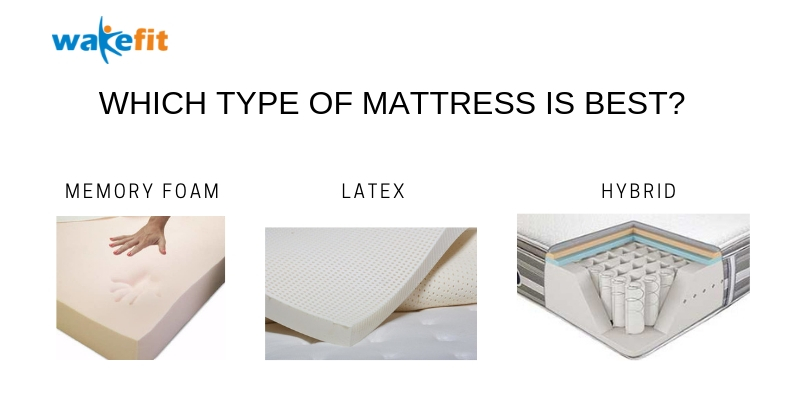

No single type wins. The right mattress depends on how you sleep, whether you run warm at night, and whether you share the bed. This covers each type honestly – what it actually feels like, where it falls short, and who it works for.
What Are the Different Types of Mattresses?
Memory Foam Mattress
The main thing people notice about memory foam is the sinking feeling – it contours under pressure and slowly returns when you move. That contouring is what handles pressure at the hip and shoulder well. It also absorbs motion, so a restless partner on one side doesn’t wake the other. The complaint that comes up most: it traps heat. Open-cell and gel-infused versions are cooler, but standard dense foam runs warm in Indian summers.
Latex Mattress
Latex is almost the opposite of memory foam. Bouncy instead of slow. You float on it rather than sink in, and changing positions at night takes no effort. It also sleeps cooler and holds its support longer – 12 to 15 years is realistic for quality latex, which is more than most foam options. The orthopaedic memory foam mattress and latex both serve people with back and joint concerns, just through a different feel.
Spring Mattress
Cheapest to buy. Air moves freely through the coil construction, so heat isn’t the problem it is with foam. But coils transfer motion – when your partner moves, you feel it across the whole surface. And support drops off faster than foam; 5-7 years is the realistic expectation before things start feeling uneven. Works for a guest room. For two people sleeping on it every night, harder to justify at a similar price point to foam.
Coir Mattress
Coconut husk fibre – natural, firm, breathable. One of the few mattresses that actually sleeps cool in South Indian summers without any special engineering. The firmness doesn’t adjust – it’s fixed and substantial. Back and stomach sleepers who want a hard surface often like it. Side sleepers generally don’t; the hip and shoulder have nowhere to sink, and pressure builds up over a night.
Hybrid Mattress
Spring base, foam or latex on top. The idea is to get airflow from the coils and contouring from the comfort layer. When both layers are quality materials, it works well. When the spring base is cheap and the foam layer is thin, it’s essentially a spring mattress with slightly better marketing. Check what’s actually inside before the category name convinces you of anything.
How Do Different Mattress Types Compare?
| Feature | Memory Foam | Latex | Spring | Coir | Hybrid |
|---|---|---|---|---|---|
| Pressure Relief | Excellent | Good | Moderate | Poor | Good |
| Spinal Support | Good | Excellent | Moderate | Good (firm) | Good |
| Breathability | Moderate | Good | Excellent | Excellent | Good |
| Motion Isolation | Excellent | Good | Poor | Moderate | Good |
| Lifespan | 7-10 yrs | 12-15 yrs | 5-7 yrs | 5-8 yrs | 7-10 yrs |
Comfort and Pressure Relief
If you wake up with a sore shoulder or hip, pressure relief is the spec to look at. Memory foam distributes weight across the surface rather than letting it concentrate at one point – that’s what makes the difference. Coir pushes back against the body instead; fine if you sleep on your back, a problem if you sleep on your side.
Support and Spinal Alignment
Both latex and high-density foam hold the spine’s natural curve well – they just do it differently. Latex through pushback, foam through contouring. Spring and coir are more variable; how evenly their support holds as they age is where the difference shows up.
Breathability and Temperature Regulation
Coir and spring, no contest. Air moves through them freely. Dense foam traps heat – that’s just the physics of closed-cell material. Open-cell foam and latex are better, but if you sleep very hot, coir or spring will still outperform them on this one thing.
Motion Isolation
Only matters if you share your bed – but then it matters a lot. Memory foam absorbs movement; a partner shifting at 2am barely crosses to your side. A spring mattress sends that movement across the entire coil network. If one of you is a light sleeper, this is the spec that will affect your nights more than any other.
Durability
Foam density is what determines how long a foam mattress holds its shape – not the price, not the thickness. A 40 kg/m³ mattress and a 25 kg/m³ mattress feel similar on day one. By year three, the lower density one has body impressions and the higher density one doesn’t. Latex skips most of this concern; it holds its shape for 12-15 years regardless.
Which Mattress Type Is Best for Different Sleeping Positions?
Mattress for Side Sleepers
Side sleeping puts the full body load on two points – shoulder and hip. A firm surface means those joints take it all night. Medium to medium-soft memory foam lets them sink just enough to relieve pressure while keeping the spine level. More detail in the best mattress for side sleepers guide.
Mattress for Back Sleepers
Back sleeping is generally easier on the spine – as long as the lower back is supported. Medium-firm memory foam or orthopaedic foam works. Too soft and the lumbar area sags; too firm and there’s a gap under the natural inward curve. The goal is a surface that holds everything level.
Mattress for Stomach Sleepers
Go firm. A soft mattress lets the hips drop, which makes the spinal extension stomach sleeping already causes worse. Coir or a firm orthopaedic mattress keeps the body flat. If you’re a stomach sleeper with lower back pain, the mattress is likely part of the problem – see the stomach sleepers guide.
Mattress for Combination Sleepers
Responsiveness is what you’re after – a surface that springs back quickly when you shift, not one that holds your shape. Heavy memory foam can feel like you’re fighting it every time you turn over. Latex or medium-firm foam with some bounce is easier to move on.
Which Mattress Is Best for Different Climates?
Mattresses for Hot and Humid Weather
Airflow matters here more than anything. Coir and spring have it by construction. In foam, open-cell or natural latex runs cooler than standard dense memory foam. If you live somewhere hot for most of the year, check this spec explicitly – “cooling” in a product name doesn’t always mean much.
Mattresses for Moderate Weather
More flexibility. When heat isn’t the main concern you can prioritise pressure relief, support, or motion isolation without one material being ruled out on temperature alone.
Mattresses for Cold Weather
Dense memory foam retains warmth and softens as body temperature rises – actually an advantage when the room is cold. Browse Wakefit’s full mattress range to filter by type and features.
Common Mistakes to Avoid When Choosing a Mattress
Choosing Only Based on Price
A ₹30,000 retail-brand mattress can have worse foam density than a ₹15,000 direct-to-consumer one. Price reflects overhead and marketing spend as much as quality. Foam density, material type, and warranty terms are what to compare – not the number on the tag.
Ignoring Your Sleeping Position
This is the one that sends most people to the wrong mattress. A side sleeper who buys firm coir because “firm is better for your back” will wake up with shoulder pain. Sleep position determines your firmness range – that comes first, before material, before price, before anything else.
Choosing the Wrong Firmness
“Firm is better for backs” is a simplification that doesn’t hold for everyone. Firmness depends on your body weight and how you sleep. A side sleeper at 55 kg and a stomach sleeper at 95 kg have almost opposite requirements – same advice won’t serve both.
Focusing Only on the Mattress Material
Low-density memory foam will underperform a well-made spring mattress at a similar price. The material type narrows the field; quality within that type is what decides whether the specific mattress is worth buying.
Frequently Asked Questions
Which type of mattress is best for sleeping?
Depends on sleep position and whether you run warm. Memory foam for side sleepers and motion isolation; latex if you sleep hot or want something longer-lasting. No type is best for everyone.
Which mattress type is best for back pain?
Orthopaedic memory foam is the most common starting point. That said, sleep position changes what “best” means here – a side sleeper with back pain needs different support than a back sleeper.
Is memory foam better than a spring mattress?
For most daily use, yes – better pressure relief, motion isolation, and lifespan. Spring wins on airflow and upfront price. Over a 10-year span, quality foam is usually better value.
Is latex better than memory foam?
Lasts longer, sleeps cooler, more responsive. Memory foam does better on pressure relief and absorbing motion. Which is “better” depends entirely on what you’re optimising for.
Which mattress is best for hot weather?
Coir and spring by a distance. In foam, open-cell or natural latex is the next best. Dense closed-cell foam is the one to avoid if heat disrupts your sleep.
Are coir mattresses good for sleeping?
For back or stomach sleepers who want firm and cool, yes. Not for side sleepers – the fixed firmness doesn’t give way at the shoulder and hip, so pressure builds up through the night.
Which mattress is best for side sleepers?
Medium to medium-soft memory foam, usually. The shoulder and hip need to sink slightly without the whole body following – that’s what medium-soft achieves where firm doesn’t.
Which mattress is best for heavy people?
High-density foam (35 kg/m³ or above) or latex, 10 inches or more, medium-firm to firm. Low-density foam bottoms out faster under higher body weight and develops uneven impressions.
How long does each type of mattress last?
Latex: 12-15 years. High-density foam and hybrid: 7-10. Coir: 5-8. Bonnell spring: 5-7. Use a mattress protector – it extends any of these.
How do I choose the right mattress type?
Four questions in order: how do you sleep, how much do you weigh, do you sleep hot, do you share the bed. Answer those and you’ve narrowed it to one or two types before you’ve looked at a single brand.

No Comments